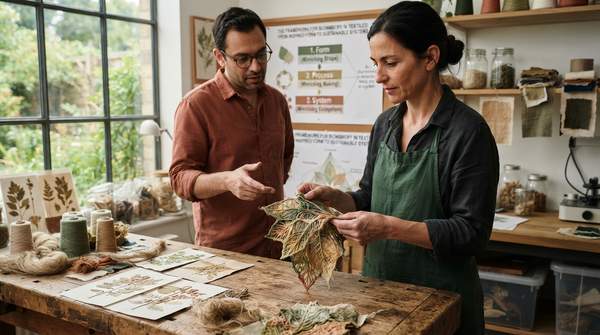
Biomimicry, the practice of learning from and emulating nature’s strategies to solve human challenges, is a powerful source of innovation in textile design. In an industry seeking to reduce its environmental footprint, turning to nature’s time-tested patterns offers a compelling path toward materials that are not only high-performing but also sustainable. Designers are creating fabrics that clean themselves like a lotus leaf, regulate temperature like a pinecone, or possess the strength of spider silk. However, a textile merely inspired by nature is not inherently eco-friendly. The true sustainability of a biomimetic product depends on the depth of its natural emulation—whether it simply mimics a form, replicates a complex process, or integrates the principles of an entire ecosystem. Understanding this spectrum is essential for critically evaluating the environmental claims of "nature-inspired" textiles.
The application of biomimicry in textiles can be understood across three distinct levels of increasing complexity and ecological integration. The most direct approach involves mimicking the form or structure of an organism to achieve a specific function. A more sophisticated level emulates a natural process, such as how an organism adapts to its environment. The most profound application mimics the principles of an entire ecosystem, focusing on circularity, decomposition, and the elimination of waste. The environmental benefit of a biomimetic textile is directly tied to which of these levels it successfully achieves, demanding a shift from simple inspiration to a more holistic, systems-based design philosophy.
Biomimicry in Textiles: A Sustainability Framework
To move beyond marketing claims and assess the genuine environmental merit of nature-inspired textiles, it is necessary to classify them based on the level of biomimicry they employ. The following framework categorizes these approaches, providing examples and analyzing the typical sustainability outcome for each level. This distinction reveals that while some biomimetic designs offer significant environmental benefits, others may replicate a natural form using fundamentally unsustainable industrial materials and methods.
| Level of Mimicry | Description | Textile Application Example | Sustainability Outcome |
|---|---|---|---|
| Level 1: Mimicking Form (Organism) | This approach replicates the specific physical structures or features of an organism to achieve a desired function. The focus is on copying a static shape, texture, or material property. | Self-cleaning surfaces inspired by the lotus leaf's microstructure; strong, lightweight fibers based on the structure of spider silk; swimwear designed to reduce drag by mimicking shark skin. | Highly variable and often limited. A nature-inspired form can be produced with unsustainable materials and processes. The classic example is Velcro, inspired by burrs, which is traditionally made from petroleum-based nylon. |
| Level 2: Mimicking Process (Behavior) | This level emulates the dynamic behaviors or processes found in nature. It goes beyond static form to include how an organism functions or adapts to its environment. | Thermoregulatory fabrics that open and close in response to moisture or heat, inspired by the behavior of pinecones or the stomata on plant leaves. | Can improve sustainability during the product's use phase by enhancing energy efficiency or reducing the need for resources like water and detergents for cleaning. |
| Level 3: Mimicking Ecosystem (System) | This highest level of biomimicry seeks to replicate the principles of entire ecosystems, focusing on interconnectedness, cyclical material flows, and waste-as-resource models. | Textiles designed for decomposition, where materials are intended to safely return to nature as "food" for other organisms at the end of their life, creating a regenerative loop. | Offers the most significant potential for sustainability by creating circular, regenerative systems that eliminate waste and pollution by design, rather than merely reducing them. |
Level 1: The Ambiguity of Mimicking Form
Many of the most recognizable biomimetic textiles operate at the level of mimicking form. Scientists have long studied the remarkable properties of spider silk, inspiring the creation of bioengineered alternatives that are both strong and lightweight. Likewise, the micro-topography of the lotus leaf, which causes water to bead up and roll off, has led to the development of self-cleaning and stain-resistant fabrics. While these innovations can dramatically enhance a product's performance, their sustainability is not guaranteed. The critical distinction lies in the materials and manufacturing processes used to achieve the nature-inspired form. An analysis in a paper on biomimicry highlights this very issue, noting that a biomimetic product "might not be eco-friendly."
The classic example of this disconnect is Velcro. Inspired by the way burrs cling to fur, the hook-and-loop fastener is a brilliant piece of biomimicry in form. However, its production tells a different story. As one academic overview points out, "The hook and loop fastener, Velcro, has been traditionally manufactured using nylon. The key ingredients are petroleum derivatives, with the usual environmental consequences of petroleum processing." This illustrates how a product can be inspired by nature in its function but entirely synthetic and environmentally burdensome in its creation. This same ambiguity applies to other form-based innovations, such as swimwear modeled after shark skin to reduce drag. The sustainability of such a product depends entirely on whether it is made from recycled materials or virgin, petroleum-based synthetics.
Level 2: Emulating Natural Processes for Efficiency
A more sophisticated application of biomimicry involves emulating natural processes to create dynamic, responsive textiles. Rather than copying a static structure, this approach seeks to replicate how living things adapt and respond to their surroundings. Researchers have developed fabrics that manage temperature and moisture by drawing inspiration from the way pinecones open their scales in dry air or how stomata on plant surfaces regulate gas exchange. These thermoregulatory materials can change their structure in response to environmental cues, opening pores to increase breathability when the wearer is warm and closing them to retain heat when it is cold.
The sustainability benefit of process-level biomimicry is often realized during the product's operational life. By actively managing thermal comfort, these textiles can reduce the need for energy-intensive heating and cooling. Similarly, fabrics with advanced moisture-wicking or self-cleaning properties can lower the environmental impact of laundering by requiring less frequent washing and drying. While the manufacturing of these advanced textiles may still be complex, their ability to improve energy and resource efficiency during use represents a significant step toward a more sustainable product lifecycle.
Level 3: Designing for an Ecosystem Role
The most advanced and ecologically integrated form of biomimicry involves designing textiles that function within a larger system, just as organisms do in an ecosystem. This approach prioritizes circularity and end-of-life considerations from the very beginning, treating waste not as an inevitability but as a design flaw. The goal is to create materials that participate in regenerative cycles, breaking down harmlessly to become nutrients for new growth. The Biomimicry Institute frames this as a fundamental shift in perspective, arguing that "The future of the circular economy hinges on creating materials that are designed to serve as food for nature’s decomposers."
This systemic approach involves making materials that are compatible with natural systems, meaning they are biodegradable and have low toxicity. Innovations in this area include creating fibers from food waste, such as pineapple and apple leathers, or growing materials like mycelium and bacterial cellulose. One initiative is exploring how to apply the principles of decomposition to transform mixed textile waste into biocompatible materials like biochar and biopolymers. By designing textiles with their eventual breakdown in mind, this level of biomimicry aims to close material loops, ensuring that products can "safely integrate into the environment without accumulation" at the end of their useful life.