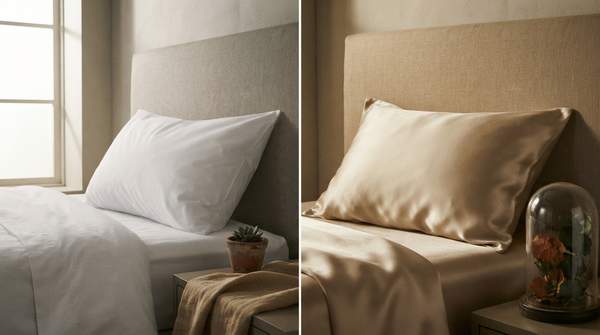
If you have textured, breakage-prone, or dry hair, or your skin tends toward dryness or sensitivity, the evidence points to silk. If breathability is your main concern and dryness is not an issue, cotton remains a reasonable choice. The difference comes down to two measurable properties: how much friction a fabric creates against a hair strand, and how much moisture it pulls away from your hair and skin overnight.
The Science of Sleep Surfaces: Friction and Hair Health
Why does the fabric under your head matter at all? Every time you shift in your sleep, your hair rubs against the pillowcase. On a rough surface, that rubbing can snag the strand and rough up the cuticle, the outer layer that protects the hair. Over many nights, that repeated abrasion shows up as frizz, tangles, and breakage.
This is not just a marketing story. TRI Princeton, an independent hair-care research institute, developed a test that measures friction between hair and fabric by pulling a hair tress between two gently pressed fabric surfaces and recording the force required. The institute notes that the same method applies to headscarves and veils as well as pillowcases, and its findings point toward silk and satin as the gentler options for hair.
Silk's advantage is structural. As the hair expert quoted in Allure's coverage explains, silk is a natural protein fiber whose "breathable, smooth, and slip-rich qualities allow hair to glide rather than snag overnight." Less snagging means less cuticle damage, which means smoother texture and healthier-looking strands over time.
Moisture Management: How Pillowcases Affect Hair and Skin Hydration
Friction is only half the story. The other half is what the fabric does to moisture. Your scalp produces sebum, a natural waxy oil meant to coat and protect each hair shaft. Wirecutter's Caira Blackwell explains the problem for textured hair: for coily, kinky, curly, or wavy hair, sebum has a harder time traveling from root to tip, which is why these hair types struggle to retain moisture and are prone to dryness and split ends.
Cotton is highly absorbent. That quality makes it comfortable and breathable for sleep, but it also means the fabric can draw moisture out of your hair and skin while you rest. For someone whose hair already struggles to hold moisture, an absorbent pillowcase can compound the problem.
Silk behaves differently. Its smooth structure absorbs less moisture from skin and hair, which is why silk pillowcases have been embraced as part of many people's skin-care routines. The Allure coverage adds that silk manages moisture differently than cotton: it wicks sweat to the fabric surface, where it dries quickly, rather than holding it against the hair and scalp.