Yes, you can replace disposable cotton rounds with washable bamboo pads — and the switch is mostly about upkeep, not sacrifice. Bamboo pads are rinsed, washed, and reused instead of tossed after one use, which reduces landfill waste and saves money over time. The real question is not whether the swap works, but what it asks of you day to day. Here is what the comparison looks like in practice.
The Environmental Cost of Disposable Beauty Tools
Disposable rounds are designed to be used once and thrown away. That convenience has a cost: a constant stream of bathroom waste that is repurchased week after week. A comparison published by the beauty brand Purexis lists disposable cotton rounds among the high-waste defaults in a typical routine, alongside plastic disposable razors, plastic loofahs and scrubbers, and plastic paddle brushes.
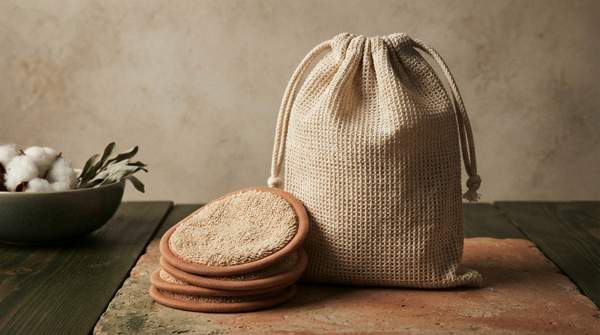
The pattern is the same across every category in that comparison. Each single-use item is treated as the traditional, high-waste option with a reusable counterpart: stainless steel safety razors for shaving, natural konjac sponges for exfoliation, and FSC-certified bamboo brushes for hair care. For cleansing, the counterpart is washable bamboo rounds, which Purexis says reduce landfill waste and save money compared with their disposable equivalents.
Why does this matter for one small item? Because cotton rounds are a daily-use product for many people. A pad discarded every night becomes hundreds of pads per year, per person, all headed to the same place. The waste is not dramatic on any single day — it accumulates quietly, which is exactly why it is easy to overlook and easy to fix.
Reusable Bamboo Rounds: A Sustainable Switch
What do you give up by switching? Very little, according to product guidance from Vue, a skincare brand selling reusable pads made with bamboo fibers. Bamboo's naturally round fibers create a smoother surface than the rougher texture of standard cotton pads, so the pads feel noticeably softer against your skin. If you have ever found a standard cotton pad scratchy on delicate areas, that difference is a genuine upgrade rather than a compromise.
The trade-off is maintenance. Unlike a disposable round, a bamboo pad only delivers its waste-reduction benefit if you rinse and wash it consistently. The savings and the sustainability both depend on the same behavior: keeping the pads in rotation instead of replacing them. Skip the care routine and you lose both the environmental case and the financial one.
It is also worth being honest about what a switch like this does not do. Reusable pads reduce landfill waste over their lifespan; they do not eliminate every environmental footprint of your routine, since they still need washing with water, detergent, and electricity. The claim that matters is comparative: over years of use, one set of washable pads displaces a large volume of single-use rounds.
Comparing Disposable Cotton Rounds and Reusable Bamboo Pads
| Factor | Conventional Cotton Rounds | Reusable Bamboo Rounds |
|---|---|---|
| Product type | Single-use tool for makeup removal and cleansing | Multi-use tool for the same tasks |
| Reusability | None — discarded after one use | Washed and reused many times |
| Primary environmental concern | Contributes to landfill waste | Reduces landfill waste; savings realized over repeated use |
| Upkeep | None — disposable by design | Rinse after each use; machine wash regularly |
| Lifespan | One use per pad | 2–3 years with proper care, per Vue's product FAQ |
Read the table as a single trade: you accept upkeep in exchange for lifespan. The disposable round asks nothing of you and gives you one use. The bamboo pad asks for a rinse and a place in your laundry cycle and gives you years of service. Neither column is wrong — they simply optimize for different things.
One quantified example shows the scale of the difference. LastObject, which makes the LastRound reusable pad, rates its pads for a minimum of 200 machine washes each. A set of seven pads, used daily, works out to more than 1,400 individual uses before any single pad would need replacing — roughly three to five years of daily makeup removal at 60°C machine washes, eliminating an estimated 1,750 single-use cotton rounds per set over its lifetime. LastObject also notes that many users report their pads holding up well beyond 200 washes when cared for properly.
Two caveats keep that number honest. First, it comes from the manufacturer of the product being rated, so treat it as a rated specification rather than an independent test. Second, the figure depends on the material, how you wash the pads, and how you use them — the same variables that determine whether any reusable pad reaches its potential.
Caring for Your Reusable Beauty Tools
Hygiene is the part most people worry about, and the care routine is simpler than you might expect. Vue's instructions are straightforward: after each use, rinse the pad under warm water until the water runs clear. That single step removes most product buildup and prevents staining, so the pads stay usable between deeper cleans.
For the deeper clean, machine wash the pads in a mesh bag with your regular laundry. Two rules protect longevity: use a gentle detergent, and avoid fabric softener — it coats the fibers and reduces absorbency. A pad that cannot absorb product cannot do its job, so skipping the softener is not fussiness; it is what keeps the pads functional.
Follow that routine and the multi-year lifespan becomes realistic rather than optimistic. Vue's own FAQ puts it plainly: with proper care, degradation should not happen for two to three years. Care is the variable that converts a purchase price into long-term value.
Bamboo rounds are not the only reusable option worth knowing. The same Purexis comparison names natural konjac sponges as the eco-friendly alternative to plastic loofahs for exfoliation, because they are compostable and shed no microplastics. If your routine extends beyond makeup removal, the reusable-versus-disposable logic applies there too. One note for anyone with specific skin conditions: these recommendations are for general skincare use, and a dermatologist is the right person to advise on your case.
Making the Switch to Sustainable Beauty
Choose reusable bamboo makeup remover pads over disposable cotton rounds to reduce waste and environmental impact, and integrate proper cleaning practices to maximize their lifespan. The decision hinges on one honest trade-off: you take on rinsing and laundry duty, and in exchange the pads stay in service for years instead of a single use.
You can measure the change concretely: a reduced frequency of purchasing disposable beauty products, and a noticeable decrease in bathroom waste. If you use a rated product like LastRound, you can also track the wash count — past 200 machine washes, every load is a bonus beyond the minimum. Either way, the indicator is visible in your own bathroom: fewer packs bought, less in the bin.
Sources
- The Best Eco-Friendly Beauty Tools for a Sustainable Glow in 2024 - Purexis — Purexis | Premium Beauty USA Brand
- REUSABLE COTTON PADS — Vue
- How Many Times Can You Reuse Makeup Remover Pads? — LastObject