Fringe began as a fix for a problem every early weaver faced: cut fabric unravels. By twisting or knotting the loose threads at an edge, artisans stopped the fraying—and accidentally invented one of design's most enduring decorative details. Over thousands of years, that practical finish evolved into bullion-edged Victorian sofas, Art Deco glamour, and today's fringed pillows and lampshades. Here is how fringe made that journey, and how to recognize its history in the pieces you live with.
The Ancient Origins: Fringe as a Functional Necessity
Why does fringe exist at all? The answer is material science, not ornament. Fringe originated as a way of preventing a cut piece of fabric from unraveling when a hem was not used, according to the standard definition of the trim: several weft threads were removed, and the remaining warp threads were twisted or braided together to lock the edge in place.
The technique of fringe dates to approximately 3000 BCE, with its use documented on garments such as shawls, robes, and ceremonial attire crafted from materials like wool, linen, and silk. In these early periods, before the widespread adoption of hems, fabric edges were secured by twisting or knotting loose threads. Design historians likewise place fringe's earliest use in ancient Mesopotamia and Egypt, where it was applied to garments and textiles to prevent edges from unraveling. In those early civilizations, the evidence describes its use on clothing and textiles generally; specific home decor applications from this period are not detailed.
From Practicality to Prestige: Fringe as a Symbol of Status
When did a knot become a status symbol? Quite early. Even in ancient Mesopotamia and Egypt, fringe did double duty: it stopped unraveling, but it also served as a symbol of status, craftsmanship, and wealth. A finely twisted, evenly spaced fringe announced that its owner could afford skilled hands and quality thread.
That dual identity—half engineering, half display—is the key to everything that followed. Once fringe signaled craftsmanship, it no longer needed a functional excuse. The trim could be made separately, elaborated, and sewn onto surfaces purely for effect, a shift that accelerated as textile trades professionalized. In modern fabrics, fringe is more commonly made separately and attached, a practice that completes the separation of form from function.
Victorian Grandeur: The Peak of Passementerie in European Interiors
Fringe reached peak popularity in the 18th and 19th centuries, particularly in European interiors, where ornate trims, bullion fringe, and passementerie added layers, movement, and texture to richly appointed homes. Passementerie—the centuries-old art of decorative trimmings—flourished in 17th and 18th century France, where skilled artisans hand-knotted tassels and trims for palaces and grand salons.
The Victorians took this inheritance to its fullest expression, draping fringe over nearly every upholstered surface in sight. The applications were specific and recognizable: bullion fringe on upholstered furniture, tasseled tiebacks on drapery, and fringed Victorian lampshades. Tassels were also used on furniture to keep upholstery trims from unraveling—a reminder that even at its most ornate, the trim's functional ancestry remained visible. Designer Juan Suvalsky's contemporary work shows the logic persisting: "We chose an extra-long tassel to underline the structure of the fabric and make the drapery/window have a more considered finish."
Art Deco Elegance: Fringe in the Roaring Twenties
After the Victorians, fringe fell in and out of vogue, but it had another heyday in the glamorous interiors of the 1920s and '30s. The Art Deco era embraced it as a favorite trim, one that added what designers describe as an edgy and classic look to home decor.
In this period, fringe appeared on home decor accessories and furniture accents within glamorous interiors. The mood had changed from Victorian abundance: Art Deco fringe was sleeker, paired with the era's bold geometry and luxurious materials rather than layered over every available surface. Interior design writers link the period's fringe aesthetic to the opulent world evoked in portrayals of 1920s wealth, such as Baz Luhrmann's adaptation of The Great Gatsby—a useful cultural shorthand for the look, if not a documentary record of it.
Modern Revival: Fringe in Contemporary Home Decor
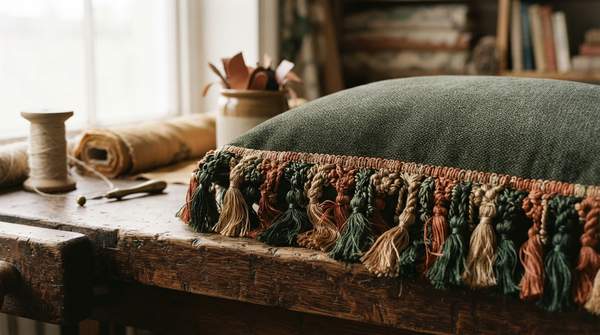
Fringe never disappeared entirely. From Victorian lampshades to hippie-style 1960s curtains, the trim kept cycling through decor, and in 2026 it is making what design writers call a serious comeback. Where can you see it now? On sofas, chairs, pillows, and beds—finishing touches that instantly make a room feel collected and just a little bit romantic, in the words of one home decor retailer.
Contemporary designers frame the revival as heritage rather than novelty. As one design writer puts it, "While fringe may feel of the moment, it's really a return to a long tradition of craftsmanship—and that heritage is exactly what makes it feel so special today." The recommended approach pairs historic influences with modern silhouettes, so the trim reads as intentional rather than stuck in the past.
The Evolution of Fringe in Home Decor: A Timeline
Use this chronology to place any fringed piece you encounter in its historical context, and to distinguish functional roots from decorative intent.
| Era / Period | Primary Use (Functional vs. Decorative) | Key Examples in Decor |
|---|---|---|
| Ancient Mesopotamia & Egypt (from c. 3000 BCE) | Functional: prevented unraveling, but already doubled as a symbol of status and craftsmanship | Applied to garments and textiles; specific home decor applications not detailed for this period |
| 17th–18th century France | Decorative: passementerie hand-knotted for palaces and grand salons | Hand-knotted tassels and trims for elite interiors |
| 18th & 19th century Europe (Victorian) | Decorative statement at peak popularity; added layers, movement, and texture | Bullion fringe and ornate trims on upholstered surfaces, tasseled drapery tiebacks, fringed lampshades |
| Art Deco (1920s–1930s) | Decorative: glamorous favorite trim with an edgy, classic look | Furniture and home decor accents in glamorous interiors |
| 1960s | Decorative: recurring trend presence | Hippie-style fringed curtains |
| 2026 (Contemporary) | Decorative: significant comeback adding charm and a collected feel | Sofas, chairs, pillows, and beds |
Read down the middle column and the story is unmistakable: fringe's job shifted from protecting fabric edges to performing style, status, and texture. Read the right column and you can date a room's sensibility by where its fringe appears.
Recognizing Fringe's Enduring Appeal in Design
Readers can confidently identify and appreciate fringe in home decor as a design element with a rich history, understanding its dual nature as both a practical textile finish and a significant decorative statement across various eras. The next time you see bullion fringe on an upholstered chair or a long tassel holding back a curtain, you are looking at a technique that began as twisted warp threads in ancient Mesopotamia and Egypt, peaked in Victorian passementerie, and returned for Art Deco glamour and today's revival.
A simple check proves the point: the reader can articulate specific historical periods where fringe was prominent in home decor—ancient Mesopotamia and Egypt, 18th and 19th century European interiors, the Art Deco 1920s and '30s, the 1960s, and the current 2026 revival—and give a concrete example for each, from tasseled drapery tiebacks to fringed pillows. That knowledge is what turns a decorative trim into a historically informed design choice.
Sources
- Fringe (trim) - Wikipedia — EN
- The Fascinating History of Fringe: From Ancient Traditions to the Hottest Trend of 2026 — Rock N Sport Store
- Fashion Archives: The History of Fringe – StartUp FASHION — Startupfashion
- Designers Say This Unexpected Historic Design Detail Is Having a MAJOR Comeback in 2026 — House Beautiful
- The Fringe Interior Design Affair – Alcove Studio — Alcovestudio
- Fringe Furniture Is Having a Moment—Here's How to Style It — Kathy Kuo Home