Natural stone and wicker both promise warmth, texture, and character, but they deliver those qualities in fundamentally different ways. Stone offers permanence, luxury, and instant visual impact; wicker and its close cousin rattan offer lightweight flexibility and a relaxed, handcrafted feel. The right choice depends less on which material is "better" and more on what a specific corner of your home is being asked to do — anchor it permanently, or soften it with a layer you can move tomorrow.
Natural Stone: Timeless Elegance and Enduring Strength
Stone suppliers and decor writers converge on one description: natural stone reads as elegant and timeless. Writing for the Hindustan Times, Ishika Narang notes that materials such as marble, soapstone, sandstone, and agate bring warmth and character through their natural patterns and finishes, lending interiors "a touch of luxury." The stone company Salvatori makes a similar case for walls, describing stone — particularly when textured — as adding "instant depth and dynamism" to a room.
Stone's practical case rests on endurance. Salvatori argues that wallpaper tends to stain more easily than stone and deteriorates more quickly, while Swenson Granite, a granite supplier, calls stone "the most elegant, durable, and efficient material around" for fireplace surrounds, noting there is no need to worry about chipping or cracking over time as there can be with painted brick. These are commercial voices, but their shared emphasis is consistent: stone is positioned as a long-horizon material, chosen once and lived with for decades.
Wicker and Rattan: Organic Texture and Casual Versatility
Wicker, by contrast, is defined by its woven technique rather than any single material — a distinction the furniture guide by Derek Brewster draws clearly, noting that artisans have woven natural fibers into "beautiful, sturdy furnishings" for centuries. Rattan, a specific natural fiber, is frequently used in wicker weaving, which is why the two names appear together so often in decor coverage.
Design writers praise wicker's combination of practicality and lightness. Writing in House Beautiful UK, Wanda Sachs reports that these natural materials are "lightweight, easy to move, durable and surprisingly versatile," and quotes interior designers describing rattan's timeless, generational appeal and wicker's ability to feel "both relaxed and sophisticated at the same time." One designer she quotes, Victoria of Casa by JJ, frames the appeal as "practical beauty" — pieces that are useful and beautiful simultaneously. A Hommés Studio design journal adds a key visual point: rattan makes an aesthetic statement without adding "a ton of visual weight" to a space.
Choosing Your Material: A Comparative Framework
The clearest way to decide is to place the two materials side by side against your actual design goal. The matrix below juxtaposes their documented characteristics — drawn from separate sources on each material — so you can see where their design roles genuinely diverge rather than overlap.
| Decision Factor | Natural Stone | Wicker / Rattan |
|---|---|---|
| Aesthetic / Vibe | Elegant, timeless, luxurious; textured stone adds depth and dynamism | Relaxed yet sophisticated; organic, handcrafted texture without visual weight |
| Key Strengths | Hardwearing and durable; suppliers report it resists staining better than wallpaper and chipping better than painted brick | Lightweight, easy to move, durable, and versatile, woven from natural fibers |
| Best For | Permanent, high-impact focal points and feature surfaces | Flexible textural layers and casual, inviting rooms; adaptable across styles from bohemian to coastal |
| Common Applications | Feature walls, fireplace hearths, mantels, and surrounds; decorative accessories like candle holders and bowls | Bedroom headboards, accent chairs, tables, dining furniture, and small introductions without committing to large pieces |
Read the matrix as a question: is this element a fixture or a layer? Stone suits the first answer, wicker the second. Maintenance requirements are general here — specific care depends on the exact type of stone or wicker, which varies too widely for one rule.
Ideal Applications for Natural Stone
Stone earns its keep where permanence and impact matter most. Salvatori recommends it for creating a striking feature wall — or a full "total look" — and notes that a feature wall in natural stone provides a backdrop to showcase a designer sofa or a cozy fireplace. Swenson Granite points to the living room fireplace as stone's signature interior moment, with homeowners choosing stone veneer and granite hearths, mantels, and surrounds to create a focal point that fits rustic, traditional, contemporary, or minimalist interiors alike.
Stone also works at a smaller scale. The Hindustan Times' festive-decor feature, drawing on stone supplier Rishabh Jain of Petros Stone, highlights functional accessories such as soapstone candle holders — decorative elements that "continue to serve a purpose long after the celebrations are over." That range is stone's real flexibility: the same material governs both the architecture of a room and the objects on its table.
Ideal Applications for Wicker and Rattan
Wicker's applications run toward the adaptable and the domestic. The Hommés Studio journal describes rattan working "just about anywhere" in a bedroom — from the headboard to the accent chair to the table — and as a dining-room material that looks elegant while its natural fibers add a sense of casualness, making a striking statement "without feeling stuffy."
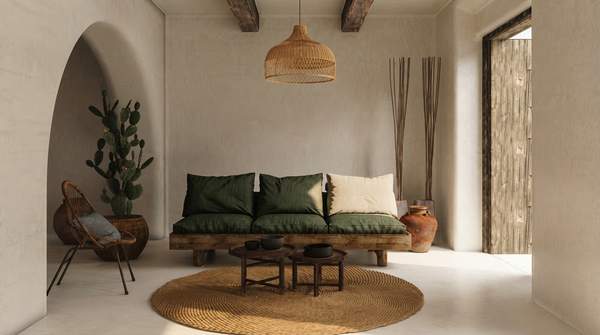
Where wicker particularly shines is in style-layered interiors. Brewster's furniture guide notes wicker's "remarkable adaptability" across design themes: bohemian spaces embrace it for its worldly, handcrafted appeal, while contemporary minimalist spaces use it to add organic warmth without overwhelming clean aesthetics. House Beautiful's reporting reinforces the low-commitment entry point — designers there suggest you can introduce woven pieces "in quite small ways without having to commit to a large piece of furniture." Dark walls, one designer notes, help wicker's texture stand out through contrast.
Making Your Material Choice
The decision, distilled: choose natural stone for permanent, high-impact features and a luxurious, enduring aesthetic; opt for wicker or rattan to add flexible, organic texture and a relaxed, versatile style. If the project is a fireplace surround or a feature wall you don't intend to change, stone's documented durability and elegance fit the job. If the goal is warmth you can rearrange — a headboard, an accent chair, a basket, a small woven accessory — wicker delivers texture without weight or commitment.
Before buying, run one concrete check against the matrix above: identify whether the item is a fixture or a layer, then confirm the material's strengths match that role. The measurable indicator of a good choice is your confidence in selecting either natural stone or wicker for that specific application, based on its aesthetic and practical fit — not on trend alone. Nothing here prices the two materials against each other, and installation and specific care instructions fall outside this comparison; both depend on the exact stone or weaving you select.
Sources
- Simple ways to give your home a warmer and classy look using natural stone in home decor — Hindustan Times
- How to decorate interior walls in natural stone — Salvatori Official
- 5 Ways to Decorate Your Home’s Interior with Granite and Natural Stone | Swenson Granite — Swenson Granite Works
- What Is Wicker Furniture? The Ultimate Guide (2025) — High End Used Furniture - Refine Your Space
- Olivia Colman’s new film has put wicker in the spotlight – here’s how to bring the look home — House Beautiful UK
- Wicker And Rattan Furniture - Natural Trend For 2020 — Hommés Studio | Modern Interior Design