The Jacquard loom automated complex pattern weaving by replacing a human assistant with punched cards: a hole in a card instructed the machine to raise a specific warp thread, and the absence of a hole left it down. Invented by Joseph-Marie Jacquard in early nineteenth-century France, the attachment converted the slowest, most skilled job in figured weaving into a repeatable mechanical sequence—and, in doing so, demonstrated for the first time that a machine could be programmed with binary instructions to carry out an automated process.
The Manual Precursor: Drawlooms and the 'Draw Boy'
Weaving itself is simple in principle: a weft thread passes over and under a set of warp threads, and the order of that interlacing determines the pattern in the cloth. The difficulty lies in the selection. To weave a figured design, particular warp threads must be raised in a precise combination for each pass of the shuttle, and that combination changes with every row.
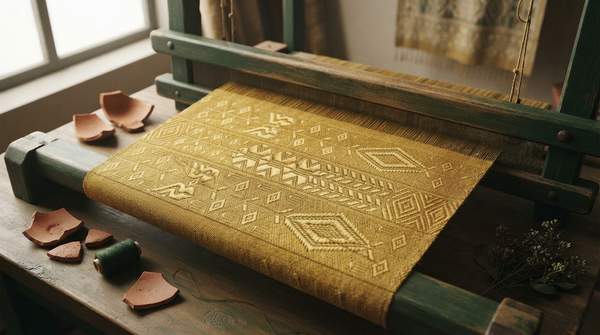
Before Jacquard, this selection was done by hand on the drawloom. As the Science and Industry Museum explains, a weaver's assistant—known as a draw boy—sat atop the loom and manually raised and lowered the warp threads to create patterned cloth, a slow and laborious process. The scale of the task was considerable: as the Science History Institute recounts, each row of weaving might contain hundreds of warp threads, so many that a second person was typically enlisted to keep track of which ones to raise or lower. The complexity of the pattern was limited by practical factors, and the work was slow and labour-intensive.
Several inventors attacked the problem—Jacques de Vaucanson designed a loom in 1745 that used a spoked metal cylinder, similar to those in music boxes, to trigger hooks that raised particular threads—but the decisive solution came with Jacquard's punched cards.
The Jacquard Revolution: Programmable Patterns
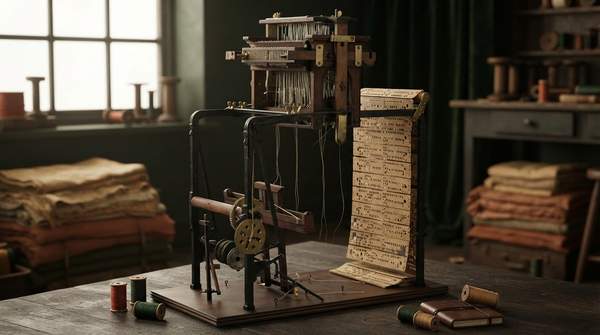
The key to Jacquard's invention was its use of interchangeable cards with punched holes that programmed the weaving pattern. This automated the laborious task previously performed by a draw boy. When fed into the Jacquard mechanism at the top of the loom, these cards controlled which warp threads were raised or lowered, allowing the weft thread to pass through and create the desired pattern.
The consequence was a qualitative change in what a loom could produce. With these punch cards, Jacquard looms could quickly reproduce any pattern a designer could think up, and replicate it again and again. The design no longer lived in the memory and muscles of a trained assistant; it lived on the cards, which could be stored, swapped, and reused. Pattern complexity was no longer bounded by human attention span or by the practical limits of manual selection, but by the number of independently controllable threads the mechanism could handle.
Jacquard Mechanism: From Card to Cloth
The sequence below traces a single instruction from the card to the cloth, showing how a binary choice—hole or no hole—becomes a physical movement of a thread. Each card fed into the mechanism represents one row of the design, and the cycle repeats for every pass of the shuttle.
| Stage | Mechanical action | Result |
|---|---|---|
| 1. Card presented | A punched card is fed into the Jacquard mechanism at the top of the loom; the card's hole pattern encodes the instruction for one row of the design. | The machine receives a binary instruction set: hole or no hole for each controlled position. |
| 2. Pins read the card | Pins are pushed toward the card; where there is a hole, a pin passes through, and where the card is solid, the pin is pushed back. | Each pin's position—advanced or retracted—is set by the card. |
| 3. Hooks selected | Each pin controls a corresponding hook. Hooks whose pins passed through the holes remain in position to be lifted; hooks pushed back by solid card are disengaged from the lifting action. | The machine selects exactly the hooks—and thus the warp threads—that this row requires. |
| 4. Griffe lifts the hooks | A rising frame (the griffe) lifts the engaged hooks, which in turn raise their attached harness cords. | Mechanical force is transmitted only to the selected threads. |
| 5. Warp threads rise | Each harness cord is connected to a specific warp thread; the lifted cords raise those threads, opening a shed. | A gap forms between raised and lowered warp threads. |
| 6. Weft inserted | The weft shuttle passes through the shed, under the raised threads and over the lowered ones. | One row of the pattern is woven; the cycle begins again with the next card. |
The power of the arrangement is in step 3: because each hook is selected independently, the mechanism can raise any combination of warp threads, not just fixed groups. That independence is what allows arbitrary, intricate designs rather than repeating geometric ones, and it is why the same machine can weave a completely different pattern simply by feeding it a different set of cards.
From Punched Cards to Computing: A Foundational Legacy
Jacquard's invention transformed patterned cloth production, but the Science and Industry Museum emphasizes its second significance: a revolution in human-machine interaction through its use of binary code—either punched hole or no punched hole—to instruct a machine to carry out an automated process. The loom is often considered a predecessor to modern computing because its interchangeable punch cards inspired the design of early computers.
The line of influence is documented and specific. The use of replaceable punched cards to control a sequence of operations is considered an important step in the history of computing hardware, having inspired Charles Babbage's Analytical Engine. As Jess Romeo explains in Scholastic Art Magazine, a hole in the card tells the loom to lift a thread and no hole means leave it down; Babbage and Ada Lovelace's ideas, though their machine was never built, laid the groundwork for modern computer programming. The first electronic computers, which did not appear until the 1940s, were programmed with punched cards and paper tape—direct descendants of the medium Jacquard pioneered.
The Enduring Legacy of Programmable Weaving
Readers should recognize the Jacquard loom as a pivotal invention that not only revolutionized textile manufacturing but also established fundamental principles of programmable control, directly influencing the development of early computing. Its two achievements belong together: the same binary encoding that freed the draw boy from the top of the loom taught engineers that a machine's behavior could be dictated by a stored, editable instruction medium. The measurable indicators of that legacy remain visible today—the continued use of Jacquard weaving principles in modern textile production, and the historical recognition of its punch-card system as a precursor to computer programming, from Babbage's Analytical Engine to the punched-card programming of the first electronic computers of the 1940s.
Sources
- Programming patterns: the story of the Jacquard loom — Science and Industry Museum
- The French Connection — Science History Institute
- The Lady, the Loom, and the World’s First Computer Article for Students