Why does chiffon pour over the body while canvas stands almost on its own? The answer comes down to two measurable physical properties: bending rigidity, a fabric's resistance to folding, and shear resistance, the friction that governs how much its yarns can slide against each other. Once you understand these two properties, and how fiber choice, yarn construction, and weave structure feed into them, you can predict a fabric's behavior before you ever cut into it.
Understanding Fabric Drape and Stiffness: The Core Physics
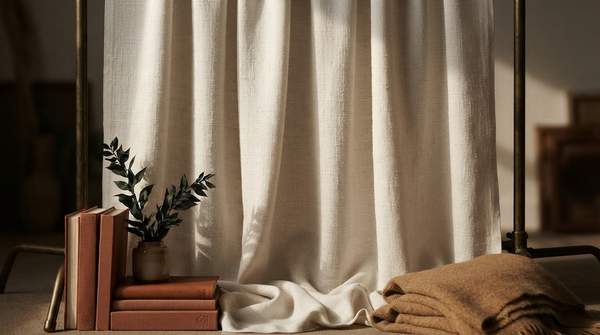
Drape describes the way a fabric hangs, falls, shapes, gathers, or flows under gravity when only part of it is directly supported. A widely used definition from the Textile Institute frames it as the ability of a fabric to hang limply in graceful folds, such as the sinusoidal folds of a curtain or skirt. Textile science literature describes it more plainly as a deformation produced by gravity when only part of the fabric is supported.
Stiffness is the mirror image: the resistance of a fabric to bending or draping. A stiffer fabric resists bending and maintains its shape, while a less stiff fabric bends and drapes easily. As one textile engineering teaching resource puts it, stiffness is essentially a function of bending length and bending rigidity, and it determines how a fabric will fall, fold, or hang in garments.
Here is the key insight for any designer: neither property works alone. Writing on the physics of fabric drape, the textile house SELVANE identifies bending rigidity and shear resistance as the fundamental components of drape, alongside weight distribution, and notes that these characteristics are engineered through fiber selection, yarn construction, and the architecture of the weave or knit. Classic research by G. E. Cusick, cited in the textile science literature, likewise established fabric drape's dependence on both bending and shear stiffness. Neither is a complete predictor on its own, but together they explain most of what you see when a fabric hangs.
Bending Rigidity: How Fabrics Resist Folding
Bending rigidity is a fabric's resistance to bending. The rule of thumb is simple: a tightly woven fabric composed of stiff, large-diameter fibers will exhibit much higher bending rigidity than a loosely woven fabric made from fine, flexible fibers. High rigidity produces crisp, structured silhouettes; low rigidity produces soft folds that collapse under their own weight.
The underlying mechanism, as SELVANE's physics explainer describes it, involves the material's Young's modulus, a measure of the fiber's intrinsic stiffness, combined with the cross-sectional geometry of the yarns. In plain terms, both what the fiber is made of and how thick the yarn is matter. A coarser yarn of the same material resists bending far more than a fine one.
Weave tightness adds a second lever. Research reviewed in the American Journal of Engineering Research, citing work by Jeong and Phillips, found that the fabric cover factor, a measure of how densely the fabric is interlaced, influences drapeability by increasing bending rigidity. The denser the interlacing, the more the fabric resists folding, and the study noted that cover factor increases drape instability by increasing residual bending curvature, meaning the fabric tends to hold the shapes bent into it.
For a designer, this chain of reasoning is practical. Do you want a fabric that folds into sharp knife pleats and holds them? Reach for a densely woven, coarser material. Do you want a skirt that falls into soft ripples? Look for fine fibers in an open weave.
Shear Resistance: The Internal Movement of Yarns
Bending rigidity explains folding, but it cannot explain the full three-dimensional flow of a draped garment. That is where shear resistance takes over. Shear resistance, sometimes called shear stiffness, describes a fabric's ability to resist forces that cause its internal structure to deform or distort.
Why does this matter for drape? Because when a fabric drapes over a three-dimensional form, the yarns within its structure must slide against each other to accommodate the new shape. The ease with which those yarns can move determines how readily the fabric molds to a body.
SELVANE's explainer gives the clearest illustration: a fabric with low shear stiffness, such as fine cashmere or vicuña, allows its yarns to shift and slide with minimal resistance, producing a fluid, supple drape that readily conforms to the body's contours. A fabric with high shear stiffness is more rigid and less capable of forming complex, multi-directional curves, resulting in a structured, less forgiving drape.
What controls shear resistance? The friction between yarns, which is affected by yarn hairiness, weave structure, and any finishing agents present. The same engineering review found evidence for this interplay: fabrics with different but similar cover factors showed differences in drapeability because of the influence of weave structure on thread interaction and the related shear properties. Two fabrics equally resistant to bending can still drape differently if their weaves let yarns slide more freely.
Notably, a study summarized on fibre2fashion confirms that a fabric's drape is affected by the type of fiber, yarn, fabric structure, method of construction, and finishing, and that manufacturers deliberately manipulate these parameters to produce fabrics with different draping qualities for different garment styles.
The Drape and Stiffness Explanatory Model
Use this model to trace a design decision from raw material to finished silhouette. Read each row left to right: the material input shapes a physical property, and the property produces the behavior you observe in the garment.
| Material Input | Governing Property | Effect on the Property | Resulting Behavior | Garment Application |
|---|---|---|---|---|
| Fiber type and fineness | Bending rigidity | Fiber type and fineness are fundamental determinants of drape and stiffness; fine, flexible fibers yield lower rigidity than stiff, large-diameter fibers | Fine fibers fall into fluid folds; coarse fibers resist folding | Fluid dresses (fine fibers) versus structured outerwear (coarse fibers) |
| Yarn structure (twist, hairiness) | Shear resistance and bending rigidity | Yarn characteristics significantly influence both properties; hairiness increases friction between yarns, raising shear resistance | Smooth, low-friction yarns slide easily for supple drape; hairy, high-friction yarns resist distortion | Supple tailored wool versus crisp, shape-holding fabric |
| Weave structure and cover factor | Both properties | Cover factor increases bending rigidity; weave structure shapes drape through its effect on thread interaction and shear properties | Dense weaves hold crisp shapes; open weaves with mobile threads flow | Structured jackets (tight weave) versus gathered skirts (open weave) |
| Low bending rigidity plus low shear resistance | Combined outcome | Both properties are low, as in loosely woven fine-fiber fabrics | Soft, fluid drape that conforms to the body | Flowing gowns and blouses |
| High bending rigidity plus high shear resistance | Combined outcome | Both properties are high, as in tightly woven stiff-fiber fabrics | Stiff, shape-retaining fabric with limited multi-directional curves | Architectural jackets and structured silhouettes |
Two cautions keep this model honest. First, bending rigidity is a crucial but only partial predictor of drape; two fabrics can share the same rigidity yet drape differently because of shear behavior. Second, the retained research does not quantify exactly how much a given change in yarn twist or fiber fineness shifts either property, so treat the model as directional, not a calculation tool.
Choosing Fabric for Your Design Vision
The decision process runs backwards from the silhouette. Select fabrics by first identifying the desired garment silhouette, fluid, moderate, or structured, and then choosing materials whose fiber, yarn, and weave properties align with the required bending rigidity and shear resistance. For fluid movement, look for fine, flexible fibers, smooth yarns, and open weaves that let threads slide. For crisp architecture, look for coarse fibers, tight construction, and high interlacing density.
One honest boundary: this model describes the fabric as woven. Finishing agents, treatments, and construction techniques such as interfacing can all alter drape and stiffness, and a study by Pant found that acrylic and polyvinyl acetate finishes substantially increased drape coefficient through added stiffness, while silicone finish slightly decreased it. This article deliberately stops at the inherent fabric.
The measurable indicator of a successful choice is simple: the garment achieves the intended silhouette and movement, whether it's a flowing drape or a crisp, structured form. Hold your chosen fabric up by one edge before cutting. If it ripples into soft folds, shear and bending are low. If it projects outward in a plane, both are high. That single observation tells you whether your material matches the garment in your head.
Sources
- Client Challenge — SCRIBD
- Client Challenge — SCRIBD
- Fabric Drape: The Physics of Luxury Textiles — SELVANE
- AJER
- Fibre2fashion