The Jacquard loom, an invention that emerged from the textile industry of the early 19th century, represents a pivotal moment in both manufacturing and technological history. By using a system of interchangeable punched cards to direct the weaving of fabric, the machine automated the creation of highly complex patterns. This innovation not only made intricate and fashionable textiles affordable for a mass market but also introduced a revolutionary concept: using a binary code to instruct a machine, a principle that would later become a cornerstone of modern computing.
How the Jacquard Loom Weaves Patterns
The genius of the Jacquard loom lies in its ability to translate a design into a series of mechanical actions using a simple binary system. The process transformed weaving from a painstaking manual art into an automated industrial process, all controlled by information stored on cards. This mechanism follows a clear, logical sequence from pattern to finished cloth.
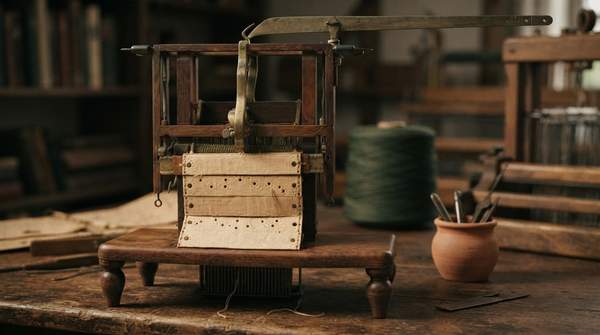
- Binary Instructions on Cards: A pattern is first broken down into a grid. Each point on the grid where a warp thread needs to be lifted is represented by a hole punched into a card. The absence of a hole represents a thread that should remain down. A series of these cards, strung together in order, contains the complete set of instructions for the entire design.
- Mechanical Reading: During operation, a set of hooks or needles presses against a card. Where there is a hole, a hook passes through and engages the mechanism that lifts its corresponding warp thread. Where there is no hole, the solid card blocks the hook, and that thread is not lifted.
- Automated Thread Control: This simple, binary action of "hole vs. no hole" allows for the precise, automated control of hundreds or even thousands of individual warp threads for each pass of the shuttle carrying the weft thread.
- Pattern Creation: As the loom cycles through the sequence of cards, the warp threads are raised and lowered according to the pattern encoded on the cards. This creates the shed through which the weft thread passes, weaving the design directly into the fabric with a high degree of precision and repeatability.
Democratizing Design in the Textile Industry
Before Joseph-Marie Jacquard's invention, producing textiles with intricate patterns was a slow, laborious process that required highly skilled master weavers. According to the Science and Industry Museum, the Jacquard machine, which built upon earlier work by inventor Jacques de Vaucanson, enabled unskilled workers to manufacture complex designs in a fraction of the time. This dramatic increase in efficiency had a profound impact on the textile market.
The ability to mechanize the production of detailed patterns meant that elaborate designs, once reserved for the wealthiest members of society, could be mass-produced. The cost of fashionable, patterned cloth fell sharply, making it accessible to a much broader consumer base. The loom's system of replaceable cards also introduced new versatility, allowing manufacturers to switch between different designs quickly and efficiently. This combination of speed, precision, and flexibility opened up new creative possibilities for designers and fundamentally changed the economics of the textile industry.