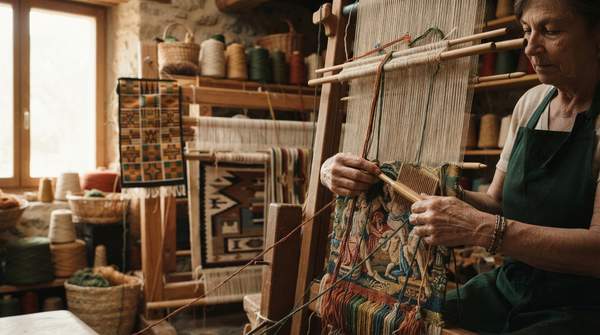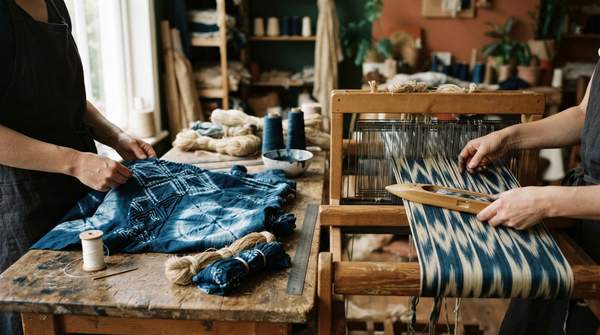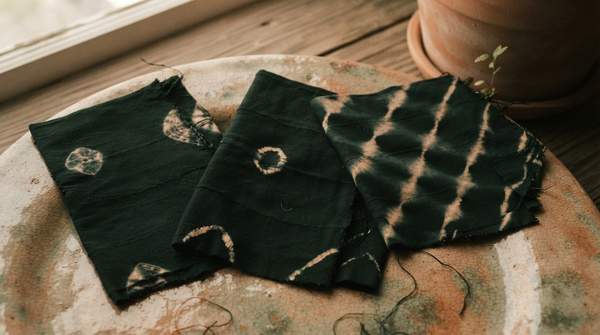
Traditional textiles are not decoration first; they are communication first. Across cultures, the way a cloth is made—whether its threads are dyed before weaving, its surface is painted with fermented mud, or its fabric is bound and dipped—determines the visual vocabulary it can carry. Three traditions illustrate this clearly: Malian Mudcloth (Bogolanfini), Japanese Shibori, and Uzbek Ikat. Each encodes identity, history, and belief through a distinct physical process, and each produces a visual language no other technique can replicate.
Malian Mudcloth (Bogolanfini): Stories in Earth and Fiber
In the Bambara language of Mali, "bogolanfini" breaks down into "bogolan," meaning "made from mud," and "fini," meaning "cloth"—a name that announces its material at the outset. The division of labor is itself traditional: men weave the cloth, while women dye it yellow and then paint its details with dye made from fermented river mud. The cloth is washed, dyed, and painted multiple times to achieve the desired color, and finally left to bleach in the sun.
The result is a fabric of striking geometric patterns, and those patterns are read as much as worn. As described by Nwami International Malta, a cultural organization, Mudcloth designs often carry symbolic meanings, telling stories of local folklore, social status, or personal journeys. The textile is typically worn during important life events and is considered a medium of cultural communication in Mali. Because the mud is applied by hand, the painter controls each mark directly, giving Bogolanfini a precise, deliberate narrative quality—every shape is placed with intent.
Japanese Shibori: The Art of Resist and Flow
Shibori is a centuries-old Japanese method of resist-dyeing fabric, described by the George Washington University Museum and The Textile Museum as a process in which an artist tightly binds or stitches sections of cloth to prevent color from penetrating. Where the cloth is bound, the dye cannot reach; where it is left open, color flows in. The pattern is therefore a record of the binding itself—a negative image of the maker's interventions.
Shibori textiles are valued for their artistic beauty and the skill they demand, and they appear in traditional Japanese clothing such as kimonos. The technique can produce a wide range of results, from intricate geometric designs to organic, flowing motifs. Unlike the painter's direct mark, the shibori maker works indirectly: the design emerges from the interplay of constraint and dye, giving the finished cloth a tension between control and chance that is central to its aesthetic value.
Uzbek Ikat: Blurred Edges, Clear Meanings
Ikat—pronounced "EE-kaht," according to the museum's account—takes the opposite approach from surface decoration: the pattern is created before the cloth exists at all. Artisans tie and dye the yarns first, then weave the colored threads into cloth. Uzbekistan's rich ikat tradition, characterized by bold colors and abstract designs, has come to embody the technique, and ikat textiles are highly prized for their vibrant colors and intricate designs.
The signature of the method is its characteristic "blurred" or feathered edge. Because the dyed segments of yarn shift slightly during weaving, the boundaries between colors soften rather than snap. That blur is not a flaw but the technique's identifying mark—the visible proof that the pattern lived in the threads before the fabric was ever assembled. In Central Asia, this demanding process produced cloths whose very difficulty signaled their worth.
Technique as Narrative: How Process Shapes Meaning
Set side by side, these three traditions reveal a consistent principle: the physical process of making a textile determines the kind of story it can tell. Bogolanfini's fermented-mud painting allows direct, repeatable mark-making, so its geometric shapes can function almost like written symbols—specific designs tied to folklore, status, or personal history, readable by those who know the vocabulary.
Shibori inverts that control. The maker defines where dye cannot go, and the resist process produces patterns whose final form depends on how the bound cloth absorbs color. Its language is one of suggestion rather than statement—organic motifs and geometric repeats whose meaning lies in the skill of their execution and their place in garments like the kimono.
Ikat disperses the design into the yarn itself. Because the threads are dyed before weaving, the weaver must hold the entire pattern in mind across two stages of making, and the finished cloth carries the characteristic blurred edge as evidence of that hidden labor. The complexity of aligning pre-dyed threads makes the vivid, intricate result a demonstration of mastery before it is anything else.
The comparison also shows what each technique cannot easily do. Mud-painting yields crisp, deliberate marks but not the flowing gradients of a resist bath. Binding yields fluid, organic patterns but not the sharp symbolic geometry of a painted sign. Pre-weaving dyeing yields depth and vibrancy across the whole cloth, at the cost of feathered, indistinct edges. Each visual language is bounded by its own physics.
Comparative Traditions: A Global Tapestry of Identity
The table below compares the three traditions across technique, symbolic function, and visual character, showing how each making process produces a distinct way of carrying cultural information.
| Tradition | Culture/Region | Primary Technique | Symbolic Function | Visual Characteristics |
|---|---|---|---|---|
| Malian Mudcloth (Bogolanfini) | Mali; Bambara culture | Handwoven cotton dyed yellow, then painted with fermented river mud; washed, dyed, and painted repeatedly, then sun-bleached | Geometric designs tell stories of local folklore, social status, or personal journeys; worn at important life events as a medium of cultural communication | Striking, deliberate geometric patterns |
| Japanese Shibori | Japan | Resist-dyeing: sections of cloth tightly bound or stitched so dye cannot penetrate | Valued for artistic beauty and skill; used in traditional clothing such as kimonos | Ranges from intricate geometric designs to organic, flowing motifs |
| Uzbek Ikat | Uzbekistan, Central Asia | Yarns tied and dyed before being woven into cloth | Highly prized textiles embodying a rich regional tradition | Bold, vibrant colors and abstract designs with a characteristic blurred, feathered edge |
Read across the rows, the pattern is clear: direct painting produces legible symbols, binding produces the interplay of control and flow, and pre-weaving dyeing produces depth at blurred boundaries. What unites all three is purpose. As Nwami International Malta puts it, the patterns found in textiles are "a universal language, rich with storytelling, symbolism, and cultural expression," each region's cloth offering a glimpse into the values, beliefs, and daily lives of the people who create it.
Decoding Cultural Narratives in Fabric
To fully appreciate a traditional textile, observe its creation technique and characteristic visual patterns as direct indicators of its cultural narrative and symbolic meaning. A crisp geometric mark points toward deliberate surface application, as in Bogolanfini's mud-painted signs of status and folklore; fluid, bounded patterns point toward resist-dyeing, as in Shibori; soft, blurred edges across the whole cloth point toward pre-weaving dyeing, as in Uzbek Ikat. The measurable test of understanding is the ability to identify the technique—mud-painting, resist-dyeing, or pre-weaving dyeing—and describe the symbolic function of a given traditional textile pattern. A reader who can look at a cloth and name both its process and its purpose has learned to read fabric as its makers intended: as a language.
Sources
- Patterns of the World: Textiles & Culture - Nwami International Malta — Nwami International Malta - Together For A Brighter Tomorrow
- Textile Traditions | The George Washington University Museum and The Textile Museum