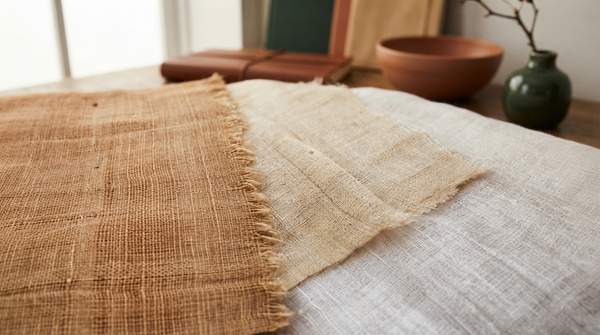
Khadi is a textile defined by a double condition: its yarn must be spun by hand and its cloth must be woven by hand. As MAIKAI's heritage textile guide puts it, "only fabric that is both hand-spun and hand-woven can be called authentic Khadi." That strict definition matters because everything else about the fabric—its breathability, its thermal behavior, its role in India's independence movement, and its modern appeal as a low-carbon fashion choice—flows from the absence of machines in its making.
What is Khadi? India's Hand-Spun, Hand-Woven Fabric
In a market saturated with mill-made cloth, Khadi occupies a distinct category. Writing for the fabric seller Metaphorracha, ravi kiran explains that the distinction begins at the yarn itself: machine-spun cotton typically carries a "Z" twist and rarely an "S" twist, whereas manually spun Khadi yarn is always an "S" twist. The direction in which the fibers are twisted is one of the few reliable technical markers separating hand-spun thread from mill output.
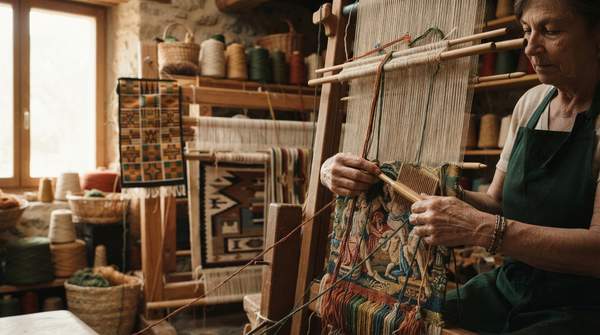
This focus on cotton Khadi is deliberate. Cotton is the fiber most commonly associated with the craft, though the term can extend to other natural fibers in practice. What remains constant is the process: fiber is drawn and twisted into yarn by hand, traditionally on a spinning wheel called a charkha, and that yarn is then interlaced into cloth on a handloom rather than a power loom.
Because no two hand-spun threads are perfectly uniform, the resulting fabric carries visible irregularities that machine production would classify as defects. In Khadi, those irregularities are the point—they are what a buyer's hand actually feels. After independence, the Indian government formalized the craft's protection by establishing the Khadi and Village Industries Commission in 1957, according to MAIKAI, to preserve and promote the tradition in a modernizing economy.
Understanding Khadi: A Three-Pillar Framework
Khadi resists a one-line definition because it is simultaneously a production method, a political symbol, and an economic system. The framework below organizes those facets so that each can be evaluated on its own evidence.
| Pillar | What it covers | Key characteristics |
|---|---|---|
| Technical definition | The process | Authentic Khadi is both hand-spun into yarn—always an "S" twist, per ravi kiran's technical description—and hand-woven into cloth, distinguishing it from machine-made textiles. |
| Physical properties | Resulting characteristics | The unevenness of hand-spun yarn produces a slub texture and a porous structure, which craft sources link to Khadi's breathability and its ability to feel cool in heat and warm in cold. |
| Historical significance | The movement | Khadi became the emblem of Swadeshi self-reliance during India's independence struggle, championed by Mahatma Gandhi, who made spinning on the charkha a daily act of disciplined protest. |
| Contemporary relevance | The impact | Proponents present Khadi as sustainable fashion with a low carbon footprint, and as a source of rural livelihoods—including employment for spinners, weavers, and dyers, with women prominently involved. |
The value of the framework is diagnostic. A fabric that feels rustic but was power-loomed fails the first pillar. A hand-woven cloth with no connection to the tradition's history still fails the full identity that buyers, institutions, and artisans mean when they use the word.
The Art of Hand-Spinning and Hand-Weaving: Crafting Khadi's Unique Properties
The chain from process to property runs directly through the yarn. When a spinner draws cotton by hand, the thread cannot hold the perfectly consistent diameter of machine extrusion. The fabric that results is therefore porous in a way mill cloth is not, and the hand-woven weave preserves that porosity rather than flattening it.
Anuprerna, an Indian fabric supplier writing about handwoven textiles, describes the consequence: Khadi's inherent textural variations give it a tactile appeal that modern consumers seek out, and it is "famously known for keeping the wearer cool in the summer and warm in the winter due to its dynamic thermal resistance." The same source explains the mechanism as the fabric's porous nature adapting to fluctuating environmental temperatures, with a typical weight of 100 to 150 GSM providing structure without sacrificing breathability. The implication is that the air trapped within the irregular weave acts as an insulating buffer in both directions.
The "slub"—those small thickened segments along the yarn—is best understood not as an aesthetic add-on but as the visible record of the human hand. Because the twist, thickness, and tension vary along every hand-spun thread, no two lengths of Khadi behave identically. This is the practical difference a reader can verify by touch: machine cloth is uniform; Khadi is alive with variation, and that variation is what produces its ventilation and adaptive feel.
Khadi's Historical Tapestry: A Symbol of Indian Independence
Kruti's historical dimension is inseparable from Mohandas Gandhi. During the independence movement, spinning one's own thread on the charkha became a deliberate rejection of British mill cloth and, by extension, of colonial economic dependency. MAIKAI's guide characterizes spinning as "a revolutionary act, a quiet protest, and a daily ritual of discipline and empowerment"—a practice that turned a domestic gesture into mass politics under the banner of Swadeshi, the principle of self-reliance.
The symbol's reach was exceptional by any measure. An essay hosted on mkgandhi.org, a site devoted to Gandhi's writings and legacy, asserts that "never in history, a piece of hand spun and handwoven cloth has played such paramount role in shaping the destiny of the country." The claim is sweeping, but it reflects how centrally the fabric was embedded in the movement's imagery: leaders and supporters alike adopted Khadi garments as visible allegiance.
That political inheritance did not end in 1947. As noted above, the creation of the Khadi and Village Industries Commission a decade later converted a wartime symbol of resistance into a state-supported rural industry, shifting Khadi's purpose from protest to livelihood.
Contemporary Relevance: Khadi in Sustainable Fashion and Artisan Livelihoods
Today the case for Khadi is made on two grounds: environmental and social. On the environmental side, ravi kiran reports that traditional Khadi production methods require minimal machinery and yield up to 60% lower carbon emissions compared to industrial textile manufacturing, and that Khadi cotton is fully biodegradable as a natural fiber that reduces landfill waste. Anuprerna frames the same point more bluntly, describing a zero-carbon footprint for the decentralized, artisan-based model it practices. The specific percentage should be read as that source's figure rather than an independently audited standard.
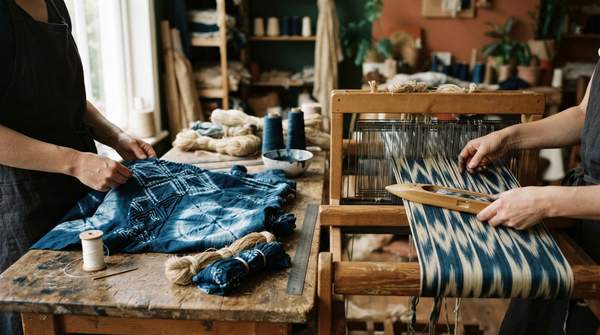
On the social side, Frankie Rose Fabrics describes the craft's economic structure: Khadi handweaving creates sustainable livelihoods for rural artisans across a network of spinners, weavers, dyers, and associated professions, generating income that helps reduce migration to cities in search of work. Metaphorracha cites the Indian Khadi industry as employing over 4.5 million artisans, a figure it presents as supporting sustainable livelihoods and preserving traditional crafts. MAIKAI, describing its own artisan collaborations, emphasizes what it calls a "fair exchange of energy, labor, and love" with craftspeople practicing hand-spinning, weaving, and natural dyeing techniques at risk of being lost.
The convergence is what places Khadi within the slow fashion conversation: a garment whose production employs people rather than displacing them, whose material returns to the soil, and whose imperfections are the signature of its making.
Choosing Khadi: A Conscious Decision for Heritage and Sustainability
The decision the evidence supports is to opt for Khadi fabric as a way to support traditional craftsmanship, rural livelihoods, and sustainable fashion practices. A reader applying the three-pillar framework can verify authenticity on the first pillar—the hand-spun "S" twist and slub texture—while understanding that the purchase also sustains the other two.
The measurable indicators to watch are the ones the sector itself reports: continued growth in artisan employment figures, such as the over 4.5 million workers cited for the Indian Khadi industry, and increased availability of Khadi products in ethical fashion markets. Those two signals, more than any marketing claim, will show whether this centuries-old craft keeps converting its political inheritance into modern livelihoods.
Sources
- Khadi: A Guide to India's Heritage Textile — MAIKAI
- Khadi Cotton: Eco-Coonscious Fabric — metaphorracha
- Handwoven Summer Fabrics: Breathable & Sustainable — Anuprerna
- Khadi: The Fabric of Sustainability and Beyond | Swadeshi-Khadi — Mkgandhi
- Unraveling the Artistry of Khadi Cotton Handwoven Fabrics from India — Frankie Rose Fabrics