The environmental case for Tencel Lyocell rests on two verifiable pillars: a manufacturing loop that recovers more than 99.8% of its solvent, and third-party certifications from TÜV AUSTRIA confirming the fiber biodegrades in soil, freshwater, and marine environments. Lenzing, the Austrian producer behind the Tencel brand, describes the process as "innovative closed loop production," and the resulting near-zero solvent wastage is what separates it from conventional viscose, which relies on chemically intensive treatment stages. For textile professionals and designers, understanding both mechanisms — how the loop works and what the certifications actually cover — is the basis for an informed material choice.
Understanding Tencel Lyocell: A Sustainable Fiber Choice
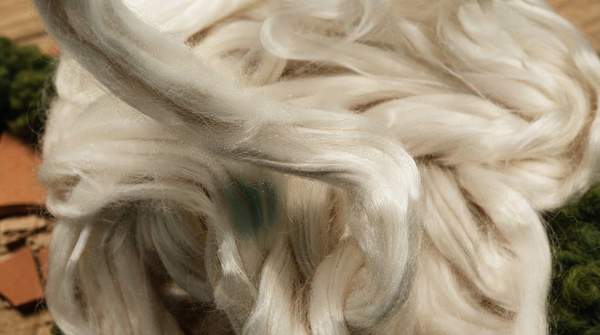
Tencel Lyocell fibers are cellulosic fibers derived from wood, a natural raw material that Lenzing says is carefully sourced from responsibly managed forests. The brand's own material chain is presented as a cycle: trees become wood, then pulp, then fiber, yarn, fabric, and garment — and at end of life, garments return to soil to nourish new tree growth. The fiber itself is valued in textile applications for its high tenacity and high moisture uptake, which translate into higher perceived thermal comfort for the wearer. But the property that has made Lyocell a reference point in sustainability conversations is its production route: dissolving pulp and regenerating fiber in a system designed to keep the solvent circulating rather than discharging it.
Tencel Lyocell Closed-Loop Production Cycle
Tracing the sequence stage by stage shows where the "closed loop" physically sits within the process, and why the recovery rate — not any single machine — carries the environmental claim. Lenzing describes two processes that transform pulp cellulose into fibers; the table below isolates the Lyocell route.
| Stage | Process | Environmental role |
|---|---|---|
| 1. Raw material | Wood pulp from responsibly managed forests | Renewable cellulosic feedstock |
| 2. Dissolution | Pulp dissolved in N-Methylmorpholine N-oxide (NMMO) | Replaces sodium hydroxide used in viscose |
| 3. Extrusion | Solution pumped through spinnerets to form filaments | Fiber shaping from the solution |
| 4. Regeneration and washing | Filament washed; cut to staple before or after washing and drying | Solvent enters wash liquor |
| 5. Drying and finishing | Opened and pressed into bales | Fiber ready for yarn spinning |
| 6. Recovery loop | More than 99.8% of solvent recovered and fed back into the loop | Close-to-zero wastage |
The loop is not a separate add-on stage: it is the recovery system acting on the wash and process streams generated in stages three through five, returning the NMMO to stage two. Lenzing also recycles process water in the same system, which compounds the resource efficiency of the route. The 99.8% figure is the manufacturer's own stated recovery rate; independent material guide Good On You, citing Lenzing AG, reports it as approximately 99%, describing the result as "almost no solvent is dumped into the ecosystem."
The NMMO Solvent Recovery Mechanism: The Core of the 'Closed Loop'
The comparison with viscose clarifies why NMMO matters. In the traditional viscose process, wood fiber is treated chemically with sodium hydroxide — a chemically intensive route. Lyocell replaces that treatment stage with NMMO, a solvent chosen largely because it is more easily recoverable. Because the solvent can be separated from the wash water and regenerated solution, it can be recycled "time and time again to produce new fibres," in Good On You's phrasing, rather than discharged. Lenzing frames the same mechanism as conversion of pulp into fiber within a closed loop, leading to a significant reduction in chemical use compared with the viscose process. Tencel Modal, by contrast, is produced in a modified viscose process with high — but not closed-loop — recovery rates of chemicals, a distinction specifiers should keep in mind.
TÜV AUSTRIA Certifications: Biodegradability and Compostability
The end-of-life claims are certified, not merely asserted. Lenzing's documentation states that its Lyocell and Modal standard fibers are certified by TÜV AUSTRIA as biodegradable in soil, freshwater, and marine environments, and compostable under both home and industrial conditions. Lyocell Filament carries biodegradability certification for soil and freshwater, plus the same compostability credentials. Two scope boundaries deserve attention. First, the certifications apply to the standard fibers; Lenzing notes they are not applicable to its Lyocell LFH or Modal Sun, Color, and Black variants. Second, the certification covers the fiber in those environments — it does not extend automatically to a finished garment, whose dyes and finishes are separate materials.
EU Ecolabel: Recognizing Reduced Environmental Impact
Tencel Lyocell also carries the EU Ecolabel for textile products. According to Lenzing's own claims documentation, the label is awarded to products with a reduced environmental impact across multiple stages of the product life cycle, with key criteria including production processes that limit the use of substances harmful to human health or the environment and that minimize key environmental impacts throughout the entire life cycle. Read together, the certifications divide the sustainability question cleanly: the Ecolabel speaks to production and life-cycle impacts, while the TÜV AUSTRIA marks speak specifically to what happens at disposal. Neither label quantifies degradation timelines, and Lenzing's published materials do not state them; specifiers needing those figures must request them directly in the context of a specific certification study.
Evaluating Tencel Lyocell for Textile Professionals and Designers
For material selection, the defensible claims stack up as follows. Production: wood-pulp feedstock, NMMO dissolution, spinneret extrusion, and a recovery loop returning more than 99.8% of solvent for reuse — a manufacturer-stated figure that Lenzing says results in close-to-zero wastage. End of life: TÜV AUSTRIA certification of biodegradability in soil, freshwater, and marine environments, and compostability under home and industrial conditions, for standard Lyocell. Life cycle: the EU Ecolabel for textile products. What lies outside these claims is equally important: generic lyocell from other producers does not inherit this evidence base, and downstream dyeing, finishing, and garment construction sit beyond the certifications' scope.
Informed Material Selection for Sustainable Design
Textile professionals and designers can confidently evaluate Tencel Lyocell as a sustainable material choice based on its closed-loop production and certified biodegradability. The decision rests on matching the claim to the need: choose the closed-loop recovery route when production chemistry is the concern, and the TÜV AUSTRIA credentials when end-of-life performance is the concern. The checkable indicator is straightforward — the presence of TÜV AUSTRIA "Biodegradable" and "Compostable" labels and the EU Ecolabel on Tencel Lyocell products — and confirming those labels on the specific fiber variant sourced, rather than the brand family, is the measurable step that converts this evidence into a verified specification.