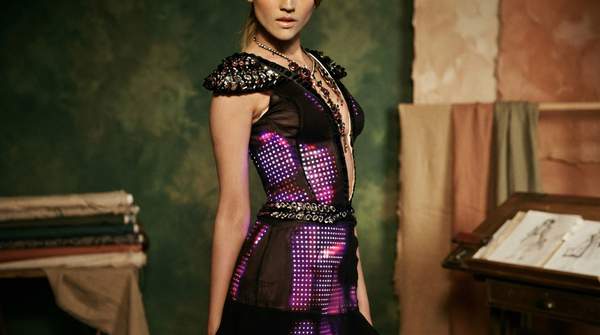
Researchers at the National University of Singapore's College of Design and Engineering have built the world's first touchscreen integrated directly into a garment, announcing on 22 October a working sleeve that displays images and video, responds to finger presses and connects wirelessly to other devices. The breakthrough is not a screen attached to clothing but a fabric in which the electronic functions live inside the fibers themselves: 54 of them, woven into a sleeve, each functioning as a pixel and a touch sensor at the same time.
What makes the announcement notable for wearable technology is what the sleeve remains after the electronics are added. According to the university's account, relayed by Tech Xplore, the garment "stays as washable, breathable and flexible as ordinary clothing," with no rigid screen involved. That combination — interactive display, touch sensing and wireless connectivity inside a textile that behaves like ordinary cloth — has been the missing piece in smart clothing, where earlier approaches typically fastened conventional components onto fabric rather than building the device into the yarn itself.
The project positions garments as a direct interface to a wearer's health data and digital devices, a shift with clear implications for medical and health-monitoring applications, where clothing is already in continuous contact with the body. The work is a research prototype; no release date has been determined, and the technology is not yet a commercial product.
NUS Touchscreen Garment: Prototype Specifications
Consolidating the figures released by the NUS team and reported across coverage of the announcement gives a compact picture of what the prototype has been demonstrated to do, and what it has survived.
| Specification | Metric / Capability |
|---|---|
| Display construction | 54 electronic fibers woven into a sleeve; each fiber acts as a pixel and senses touch simultaneously |
| Demonstrated functions | Displays images and video; responds to finger presses; connects wirelessly to other devices — functions comparable to early generations of smartphones |
| Wash durability | Display and touch sensitivity endured 50 machine-washing cycles without degradation |
| Flexibility durability | Display and sensitivity maintained after 1,000 bending cycles |
| Wearability | Breathable and flexible, described as remaining like ordinary clothing |
| Commercial status | Research prototype; no release date determined |
The durability row is the one that separates this prototype from most prior smart-textile efforts. FREEYORK's report of the announcement highlights the 50 machine washes and 1,000 bending cycles as evidence that the fabric's display output and touch response survive both laundering and repeated flexing — the two conditions that most often destroy conventional electronics sewn into clothing. The breathable, flexible design is what makes daily wear plausible rather than theoretical.