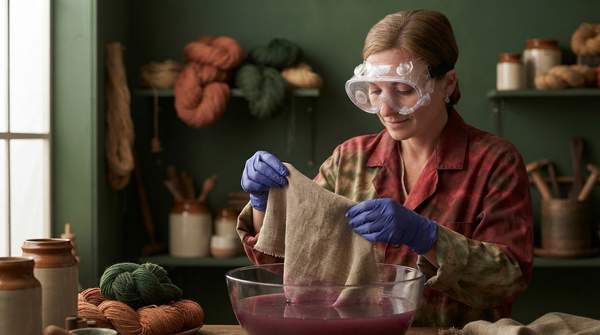
Recycling a polyester-cotton T-shirt with enzymes is a two-act process: one set of enzymes dissolves the cotton into glucose, and a second enzyme unzips the polyester back into its original plastic building blocks. The approach, described by the GEMS-Taiwan research team as a "dual-enzyme degradation system," works precisely because enzymes are selective — each class targets one fiber and ignores the other. Here is how the sequence runs, what each enzyme produces, and where the technology still falls short.
The Challenge of Blended Textile Waste
Why are blends so hard to recycle? A review of textile recycling strategies notes that conventional mechanical routes are "generally ineffective for blends," because shredding and fiber opening cannot separate the intermingled components, and the result is typically downcycling. To recycle a blend fiber-to-fiber, you need a process that can selectively separate, dissolve, or depolymerize one component while preserving the integrity of the others — and performance is measured by separation efficiency, recovery yield, purity, and compatibility with downstream spinning or regeneration. Enzymes are attractive precisely because they offer that selectivity.
Enzymatic Recycling: A Selective Approach
Instead of shredding the fabric, enzymatic recycling dismantles it at the molecular level. The GEMS-Taiwan team presents its approach as a "low-energy, modular, and scalable alternative to traditional recycling methods" for PET-cotton blends. Its system pairs two enzyme tools: engineered Tfcut2, an enzyme designed to break down PET, and a cellulase cocktail that attacks the cotton side. The principle is simple — if each enzyme only recognizes one substrate, you can run them in sequence on a single blended fabric and recover two distinct material streams from what was an inseparable mixture.
The Dual-Enzyme Pathway for Polyester-Cotton Recycling
The full recovery pathway runs in defined stages. Each enzyme is mapped to its specific fiber and its resulting product, so you can trace exactly where the cotton and the polyester each end up.
- Chemical pretreatment — target: the whole fabric. The process begins with chemical pretreatment using sodium hydroxide (NaOH), which loosens the textile structure and reduces crystallinity, making the fibers more accessible to the enzymes. No enzyme acts yet; this step only prepares the substrate.
- Cellulose hydrolysis — target: cotton. A customized cellulase cocktail, including the enzymes CbhA, BhBglA, and BsEgls, hydrolyzes the cotton-derived cellulose into glucose. The cotton fraction is thereby converted from solid fiber into a soluble sugar stream.
- PET depolymerization — target: polyester. A PET-depolymerizing enzyme — engineered Tfcut2, in this system — breaks the polyester down into its constituent monomers, enabling recovery of the plastic's original building blocks.
- Material recovery — target: both outputs. After enzymatic action, the glucose stream and the PET-derived products are separated, for example by filtration, leaving two distinct fractions that can each feed a recycling pathway.
Read this sequence as a map: pretreatment opens the door, cellulase takes out the cotton, the PET-depolymerizing enzyme takes out the polyester, and filtration splits the results into recoverable streams.
Step 1 and Step 2 in Detail: Why Pretreatment Comes First
The order matters. NaOH pretreatment is not a preliminary housekeeping step — it reduces the crystallinity of the fibers, and lower crystallinity is what makes the polymers physically accessible to their enzymes. Without it, the enzymes would face a tightly packed, resistant substrate. The team's business plan likewise describes the cellulase cocktail as supporting "pretreatment to enhance degradation efficiency," underlining that the chemical and enzymatic steps are designed to work together rather than as independent operations.
Once pretreatment has opened the structure, the cellulase cocktail hydrolyzes the cotton cellulose into glucose. Glucose is an ideal output because it is soluble, separable, and useful. Researchers at NC State, whose 2023 study "Enzymatic textile fiber separation for sustainable waste processing" appeared in the journal Resources, Environment and Sustainability, reported working on a project to feed the resulting glucose syrup into an anaerobic digester to make biofuel — as one researcher put it, "We'd be taking waste and turning it into bioenergy, which would be much better than throwing it into a landfill."
With the cotton gone, the remaining polyester is depolymerized by the engineered PET-depolymerizing enzyme. This returns the PET toward its original monomers rather than merely shredding it, which is what distinguishes depolymerization from downcycling. Afterward, filtration separates the glucose stream from the PET-derived fraction, and both are noted to have potential for recycling.
Technical Challenges and Future Outlook
Is this process ready for industrial scale? Not yet. The recycling-strategies review frames enzymatic approaches as full of promise but facing "technical and practical challenges on the road to wide adoption." The evidence points to several of those hurdles directly:
- Pretreatment is mandatory, not optional. The documented process depends on NaOH pretreatment before any enzyme acts, adding a chemical step to what is otherwise a biochemical process.
- Enzymes are substrate-specific. The cellulase cocktail works on cellulose; the engineered cutinase-type enzyme works on PET. Other synthetic fibers commonly blended into garments are not addressed by this documented system and would require their own enzymatic tools.
- Mechanical recycling cannot substitute for blends. Because shredding cannot selectively recover components, enzymatic or other advanced separation is required for genuine fiber-to-fiber recycling of blends.
On the upside, the approach's low-energy and modular character is what makes it worth scaling: the enzyme system can be applied to a waste stream without the high temperatures associated with other depolymerization routes, and both output streams — sugar and plastic monomers — have identifiable downstream uses, from biofuel production to plastic regeneration.
Enzymatic Recycling: A Path to Sustainable Textile Recovery
The evidence supports a clear decision: adopt enzymatic recycling for polyester-colyester-cotton blends to recover valuable raw materials and reduce textile waste. The dual-enzyme pathway — NaOH pretreatment, cellulase hydrolysis of cotton into glucose, PET-depolymerizing enzyme action on polyester, and filtration of the two streams — turns a fabric that mechanical recycling can only downcycle into two recoverable material streams. The measurable indicator of progress is increased availability of recycled glucose and PET monomers from blended textile waste streams, alongside the development of more efficient, broader-spectrum enzymes. Watch for those two signals — recovered monomer volumes from blend waste, and new enzymes targeting fibers beyond PET and cotton — as the milestones that tell you whether this pathway is moving from promise to practice.
Sources
- Entrepreneurship — 2025
- MDPI
- Researchers Separate Cotton From Polyester in Blended Fabric — NC State News