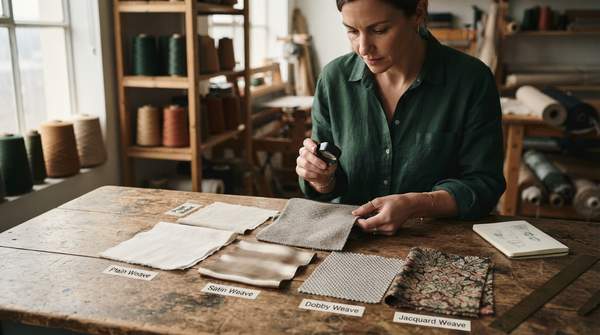
You can predict how a fabric will feel and drape before you ever touch it. The secret is structural: the fiber a textile is spun from, the twist of its yarn, and the frequency with which those yarns interlace all combine to determine its hand. Master three basic weave structures—plain, twill, and satin—and you gain a working predictive tool for material selection.
The Foundation: Fiber and Yarn Structure
Fabric hand begins at the yarn. The way warp (lengthwise) and weft (crosswise) yarns are interlaced forms what SELVANE's editorial team calls the fabric's skeleton, and that structure shapes drape by controlling how much the yarns can move and shift.
Twist matters just as much as interlacement. SELVANE describes the choice as a delicate balance: while a lower twist enhances drape, a twist that is too low produces a yarn that is weak and prone to pilling. As their guide puts it, "The art of spinning lies in finding the optimal twist for a given fiber to achieve the desired balance of softness, strength, and drape."
Fiber packing and linearity matter too. Untextured filament yarns, with their high packing density and fiber linearity, lead to a smooth, incompressible feel in fabric, according to a yarn-factors analysis hosted on Scribd. That evaluation also found that hand was primarily determined by weave and by whether air-jet-spun or ring-spun yarns were used.
Comparing Weave Structures: Hand, Drape, and Performance
Use this comparison to move from a fabric's visible structure to its likely feel. The pattern is consistent: the more often yarns interlace, the less they can move, and the stiffer and less breathable the fabric tends to be.
| Weave | Interlacement | Yarn Mobility | Resulting Drape | Typical Feel | Air Permeability |
|---|---|---|---|---|---|
| Plain | High | Low | Low (crisp, structured) | Firm, sturdy, relatively rough | Lower |
| Twill | Medium | Medium | Medium (pliable, moderate) | Slightly thicker, textured diagonal | Intermediate |
| Satin | Low | High | High (fluid, supple) | Smooth, silky, lustrous | Higher |
The underlying logic is yarn mobility. Each interlacing point pins a yarn in place. Plain weave interlaces at every crossing, so its yarns barely shift. Satin lets long spans of yarn float free, so those yarns move readily and the fabric flows. Twill sits between the two, which is why it balances structure with give.
Plain Weave: Crisp and Structured
Plain weave is the most basic structure: each weft yarn passes over one warp yarn and under the next, forming a simple crisscross. Because it interlaces at every crossing, yarn mobility is at its lowest, and the fabric tends toward a crisp, structured drape.
Thread Collective describes the result as a sturdy fabric with a relatively rough texture, suitable for a wide range of applications. That firmness is exactly why plain weave suits garments that need to hold shape rather than flow.
Twill Weave: Durable with Distinct Drape
Twill is recognizable by its diagonal lines, created by shifting the interlacing point in each row. That slight shift gives twill its signature look and feel, as Omid Yasharpour explains at My Textile Fabric. You likely own it already: the faint diagonal ridges on denim are the weave itself, not a printing effect.
With fewer binding points than plain weave, twill yarns move more freely, producing a better drape than plain weave along with a slightly thicker, wrinkle-resistant texture. Twill adapts across weights, from lightweight silk scarves to heavyweight workwear denim, which makes it a versatile middle ground: durable enough for jeans and upholstery, pliable enough for garments that need to follow the body.
Satin Weave: Smooth and Fluid
Satin minimizes interlacement by letting warp yarns float over weft yarns in long, uninterrupted spans. Those floating spans allow maximum movement and flexibility, resulting in a fabric that SELVANE describes as exceptionally fluid and supple, with a smooth, lustrous surface.
The trade-off follows directly from the structure: because relatively few points bind the yarns together, the long floats that create satin's silkiness also leave it more prone to snagging. The degree of luster and fluidity still varies with fiber type and yarn construction, so a cotton satin will feel different from a silk satin even with the same weave.
Beyond Feel: Weave's Impact on Performance
Structure affects more than touch—it changes measurable physical properties. In a study of weave and weft type in hemp–linen fabrics, the lowest air permeability was observed in the plain-weave hemp and linen samples, which were the least porous at 75% porosity. The fabrics with the highest porosity, 78%, exhibited the highest air permeability.
In other words, the same tight interlacement that makes plain weave crisp and structured also makes it the least breathable of the three basic weaves, while more porous constructions allow more air to pass. When you choose a weave, you are simultaneously choosing breathability, not just aesthetics.
Two caveats keep these principles honest. Finishing processes such as chemical treatments and brushing can significantly alter hand, but they sit outside this structural picture. And every rule here scales with the fiber and yarn twist involved: a loose plain weave in soft wool will feel different from a tight one in linen.
Making Informed Choices: Predicting Fabric Hand
When selecting fabrics, consider the interplay of fiber, yarn twist, and weave structure to predict the fabric's hand, drape, and performance characteristics like breathability. The checklist is short: identify the weave, count the binding points, and ask how freely the yarns can move.
The measurable indicator that you have chosen well is simple: the chosen fabric's actual drape and feel align with the predicted characteristics based on its weave structure and yarn properties. Hold a satin against a plain weave of similar weight and you should feel the difference the interlacement frequency predicts—crisp structure on one side, fluid suppleness on the other.