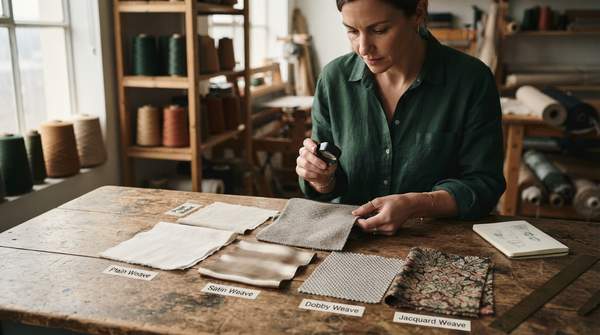
Every woven fabric you touch begins with the same raw decision: how warp and weft yarns interlace. That single structural choice—made on the loom—determines whether your fabric resists abrasion, drapes in soft folds, holds a crisp shape, or carries an intricate woven picture. Choose the right weave, and your project works. Choose the wrong one, and even beautiful fabric fails at its job. This guide maps the five most common weaves to their typical properties so you can match structure to purpose with confidence.
The Basic Weaves: Plain, Twill, and Satin
Plain weave is the workhorse. Yarns alternate over and under in a strict one-by-one sequence, reversing at each pick. According to the textile glossary published by Première Vision, it is the most stable of all weaves and has neither a distinct face nor a back. Familiar examples include poplin, taffeta, and muslin. Its frequent interlacing points give high dimensional stability, which is why industrial producers rely on it for coverings and filters.
Twill builds diagonal ribs into the fabric by passing a yarn over two or more warp yarns and under one, shifting position on each successive pick. Right-hand twill runs from lower left to upper right—the most common direction in denim—while left-hand twill runs opposite and, paired with right-twist yarns, tends to soften over time. Because the intersections are less frequent than in plain weave, twill is suppler and drapes more softly, while the diagonal structure keeps it strong and abrasion-resistant.
Satin pushes interlacing to the minimum. Fewer binding points allow long yarn floats to sit along the surface, creating the smooth texture and lustrous sheen satin is known for—and excellent drape. The trade-off is durability: those long floats snag more easily than plain or twill surfaces, and TEXBER, a textile industry firm, notes satin offers lower abrasion resistance than plain or twill weaves.
Complex Weaves: Dobby and Jacquard
Plain, twill, and satin describe how yarns interlace. Dobby and jacquard describe something different: how much control the loom has over individual warp yarns, and therefore how intricate the woven pattern can be.
A dobby loom raises and lowers warp yarns in small groups, producing smaller, subtler repeating geometric patterns—pin dots, small diamonds, textured stripes. Dobby fabric is typically used for understated texture rather than bold design.
A jacquard loom goes further: it controls individual warp yarns independently. As the writers at Fashion Index explain, this allows intricate, large-scale motifs to be woven directly into the fabric itself rather than printed on top. Brocade-style florals, damask scenes, and detailed pictorial designs are jacquard territory. The pattern potential is nearly unlimited, though the cost and complexity of production rise accordingly.
Simple vs. Complex Weaves: A Matter of Loom Control
So where is the real dividing line? It is not the interlacing pattern itself. Plain, twill, and satin are structurally distinct but mechanically simple: a basic loom can produce them because the warp yarns move in predictable, repeating sequences.
Dobby and jacquard fabrics, by contrast, can use any underlying structure—including plain or satin—but require a loom capable of lifting specific warp yarns on specific picks. The dobby mechanism handles small repeating geometric sequences; the jacquard head manages independent control of every warp end, unlocking large, non-repeating designs. In short: simple weaves answer "how do the yarns interlace?" Complex weaves answer "how much pattern can the loom command?" Both questions matter when you shop.
Weave Comparison Table: Properties at a Glance
Use this table to scan the trade-offs across all five weaves. The structural differences in the first column drive the properties in the columns that follow—that is the reasoning path from loom to fabric in your hand.
| Weave Type | Interlacing Pattern | Durability/Strength | Drape/Flexibility | Texture/Appearance | Common Uses |
|---|---|---|---|---|---|
| Plain | Yarns alternate over and under, reversing each pick | High strength and dimensional stability; some studies report lower tensile strength than twill or satin due to contact friction and crimp | Firm, least flexible of the basics | Flat, no distinct face or back | Poplin, taffeta, muslin; industrial fabrics, coverings, filters |
| Twill | Over two or more, under one, shifting each pick to form diagonal ribs | Good abrasion resistance, often stronger in tension than plain weave | Supple, softer drape than plain weave | Diagonal lines; softens with wear (left-hand twill with right-twist yarns) | Denim, upholstery, workwear, decorative textiles |
| Satin | Few interlacing points; long floats on the surface | Lower abrasion resistance; prone to snagging | Smooth, excellent drape | Lustrous, smooth face | Fashion and commercial textiles |
| Dobby | Any base structure with small grouped warp lifts | Depends on underlying structure | Depends on underlying structure | Small, subtle repeating geometric patterns | Textured shirtings, understated home decor |
| Jacquard | Any base structure with independent warp control | Depends on underlying structure | Depends on underlying structure | Intricate, large-scale motifs woven into the fabric | Brocade, damask, upholstery, statement garments |
One nuance deserves attention. Plain weave looks like the durability champion on paper because of its tight interlacing, yet a study of hemp–linen fabrics published in PMC and separate mechanical research both report lower tensile strength for plain weave than for twill and satin, attributed to contact friction and crimp. Stability and tensile strength are not the same property—plain weave maximizes the former, twill often wins the latter.
Choosing the Right Weave for Your Project
How do you turn this into a decision? Match the weave to the function first, appearance second. As Fashion Index's guidance puts it, consider how much stability, drape, durability, or texture your design requires, then evaluate weave structure alongside fiber content, weight, and finishing.
If durability is your priority—heavy-duty workwear, upholstery, or anything that will be rubbed and stressed—twill is your default. Its diagonal structure delivers good abrasion resistance while staying flexible enough to move with the wearer. For maximum dimensional stability, choose plain weave: uniforms, structured linings, and crisp shirting fabric.
If drape and luster lead your list—flowing evening wear, lingerie, elegant drapery—satin delivers, provided you accept the snagging risk that comes with long floats. For pattern, ask how big your design needs to be. Small, repeating texture points to dobby. Large, intricate woven motifs point to jacquard.
Remember the boundary of all this guidance: these are typical properties for each weave, but fiber content, yarn type, and finishing processes can shift the results significantly. A polyester twill and a linen twill will not behave identically.
Making Your Fabric Choice: A Weave-Informed Decision
To select the optimal fabric, prioritize the desired functional properties—durability, drape, stability, pattern complexity—and match them to the inherent characteristics of the weave structure. Before you buy, you should be able to articulate why a specific weave suits your project: twill for durable workwear because its diagonal interlacing resists abrasion while staying supple; satin for flowing evening wear because long surface floats give drape and luster at the cost of snag resistance; plain weave for crisp stability; jacquard when the design itself must be woven, not printed. That articulation—structure linked to function—is the measurable test that you have chosen the right fabric, and it applies to apparel and home decor alike.
Sources
- Textile Glossary: Basic weaves — Première Vision
- How Does the Weave Type Influence Fabric Strength? - TEXBER
- Common Fabric Weave Structures Explained — Fashionindex
- Effect of Fabric Structure on the Mechanical Properties of Woven Fabrics — Austinpublishinggroup