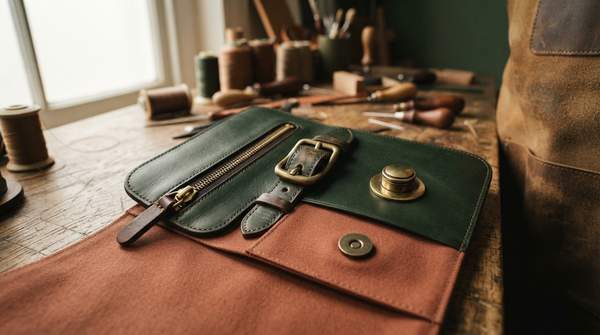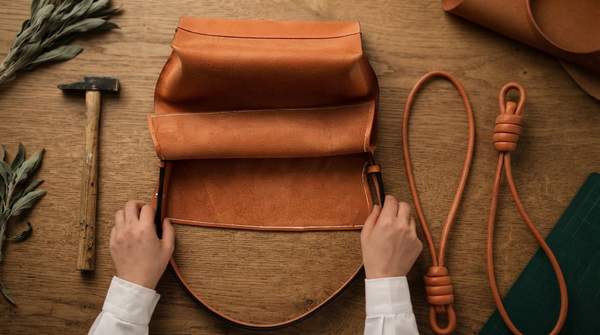
A handbag keeps its shape because of what is hidden inside it. Beneath the outer leather or fabric panels sit internal reinforcements—interfacings, cellulose boards, foam, and sometimes a rigid frame—that determine whether a bag slouches softly or stands like architecture. Choose those hidden layers correctly, and the bag holds its silhouette for years. Choose them poorly, and it sags, bubbles, or collapses under load.
The Foundation of Form: Understanding Handbag Structure
Every bag is an assembly of parts with distinct jobs. The outer shell and panels—leather, fabric, or other materials—form the visible exterior, and their own thickness and flexibility already influence the final shape. Gussets form or expand the sides, while the base contributes stability. Internal support layers help those panels retain their intended form.
Importantly, structure does not require rigidity everywhere. A structured handbag may use internal support layers or a frame, but not every structured design needs rigid components. The right choice depends on the stiffness, weight, and flexibility you want, as the designers at MOYA Bags Studio explain. Arsutoria School's technical instructors make the same point from the craft tradition: every element, from handles to reinforcements, plays a precise role in shaping the bag's aesthetic, functionality, and durability.
Internal Reinforcements: The Core of Shape Retention
How do professionals decide what goes inside? They evaluate reinforcements on two measured characteristics. According to Arsutoria School, "hand" describes how the material feels—rigid, flexible, dry, or soft—while thickness is measured with a gauge and expressed in millimeters or tenths of a millimeter, such as 8/10 for 0.8 mm. These reinforcements are chosen based on the construction type and the desired aesthetic or feel.
Interfacings are the most familiar category. As the sewing writer behind bag.uettes describes, they are fabric interlayers usually fused to the wrong side of fabric to reinforce, stabilize, and stiffen it. A light, limp canvas, once interfaced, can behave like an intrinsically stiff waxed canvas. Interfacings can also be sewn in or sandwiched between layers as a general interlining.
Comparative Guide to Handbag Reinforcement Materials
Use this comparison to match a reinforcement category to the silhouette you want. The reasoning is straightforward: the material's hand and thickness, combined with how it is applied, produce the structural outcome.
| Material category | Key properties (hand, thickness) | Application method | Best for (structural outcome) |
|---|---|---|---|
| Interfacings | Reinforce, stabilize, and stiffen fabric with varying degrees of stiffness; specific hand and thickness depend on the product type | Typically fused to the wrong side of fabric; can also be sewn in or sandwiched between layers | Support and shape retention for soft to moderately structured bags, without extreme rigidity |
| Stiffeners (cellulose board, sold as Texon, Bon Tex, or Web-Tex) | Paper-like boards of natural fiber (wood pulp, cellulose) bonded with elastomers; lightweight, dimensionally stable; available in multiple thicknesses—for example 0.45 mm sheets, or Texon's Vogue line in gauges from 0.30 mm to 1.50 mm | Cut to panel shapes and glued between layers during assembly, as an internal insert | Rigid, defined structures: bag bodies, bottoms, gussets, flaps, and strap ends; architectural silhouettes |
| Plastic sheet stiffeners | Stiffness varies by polymer family—PE and PP behave differently—so identify the polymer and review thickness, dimensions, and flexibility target before comparing samples | Cut to size as a defined insert or panel | Designs needing a precisely cut, defined panel insert |
Thickness is the main dial within each category. Springfield Leather's product guidance notes that thinner Bontex gives subtle reinforcement without bulk, while heavier thicknesses provide considerably more support for structured bags, bottoms, and panels. Texon's own specifications show the same range logic: one cellulose line runs from 0.30 mm up to 1.50 mm, in sheets or rolls.
Frames and Their Architectural Influence
When interlinings are not enough, a frame takes over. A structured handbag may use internal support layers or a frame, and frames are what give many classic silhouettes their hard, defined edges. Frame hardware is also a manufacturing consideration: MOYA Bags Studio lists it alongside complex shapes and layered reinforcement as a factor that changes how a product must be assembled. A frame adds parts and assembly steps, but it delivers a silhouette that soft reinforcements cannot hold on their own.
Seams and Construction: The Unseen Strength
Reinforcement is only half the story. How panels are joined determines whether the structure survives use. Arsutoria School's instructors emphasize that construction techniques—many part of the Made in Italy heritage—are where quality hides, in details invisible to the untrained eye. Every element from the bottom panel to the side panels plays a role in the bag's aesthetic, functionality, and durability.
Construction choices also carry trade-offs. Fusible interlining is convenient, but as textile specialists at Uneed Textile caution, if adhesives or bonding parameters are not well matched, problems like bubbling, stiffness, or bond failure may occur. Sew-in methods avoid those risks at the cost of more work. Interlining can also add bulk, so good design balances structural support against minimal added weight.
Translating Structure into Aesthetic and Durability
What does this mean when you sit down to design? Structure is a chain of decisions, and each one moves the outcome. A soft, foldable bag needs only light interfacing or an inherently stiff fabric. A rigid, architectural bag needs thick cellulose or plastic inserts, possibly a frame, and construction methods that can carry them.
Complexity is the price of definition. Complex shapes, multiple compartments, frame hardware, and layered reinforcement all influence how a product is made, requiring additional assembly steps, specialist components, or more demanding construction methods. That investment buys durability and a defined aesthetic—but it should be identified early enough to inform design decisions, with practical implications explored as the product develops.
Making Informed Structural Choices for Your Handbag Design
Designers and craftspeople should select internal structural components by first defining the desired aesthetic—rigid, soft, or structured—and the functional requirements such as durability and load-bearing, then matching these to the specific properties and application methods of reinforcement materials, frames, and seam finishes. Start with the silhouette, work backward to hand and thickness, and let the construction method follow.
The measurable indicator of success is the consistency of the handbag's shape retention and its long-term structural integrity under typical use. Watch for the specific failure modes the evidence identifies: bubbling or bond failure in fused layers, added bulk from heavy interlining, and sagging where reinforcement was too thin for the panel it supports. A bag that holds its intended form through daily use is the proof that the hidden structure was chosen well.
Sources
- How Handbag Structure Affects Design, Function & Production — MOYA Bags Studio
- The Essential Vocabulary of Bag Construction and Anatomy • Arsutoria School
- Adding Structure to a Bag — bag.uettes
- Bags & Belts — Texon - by COATS FOOTWEAR
- Bontex Bag Stiffener — Springfield Leather Co
- How Do Lining and Interlining Differ in Garment Construction? - Uneed Textile