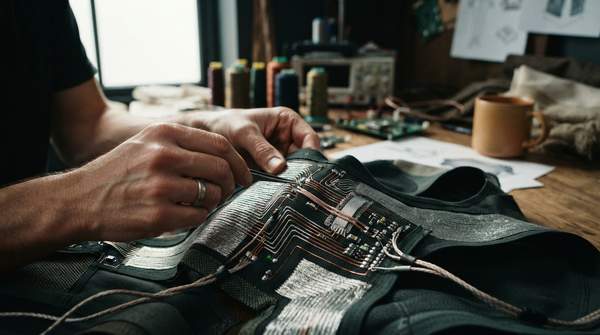
Smart textiles for health monitoring work by turning the garment itself into an electronic platform: conductive materials woven or printed into the fabric detect physiological changes—temperature, heart activity, breathing, movement—and convert them into measurable electrical signals, which embedded processing and transmission systems then carry to monitoring equipment. The fabric substrate, as IEEE's Technology Navigator explains, is treated not as a passive covering but as a platform for distributed sensing and computing, allowing continuous data collection without the discrete hardware bulk of traditional wearable devices.
Introduction to Smart Textiles for Health Monitoring
The defining distinction between a smart textile and an ordinary wearable device is where the sensing happens. IEEE defines smart textiles as fabrics that incorporate electronic components, conductive materials, or functional fibers to sense, process, or respond to stimuli from the wearer or the surrounding environment. The sensor is not a box strapped to the wrist; it is distributed through the weave of the garment itself, sitting in direct and continuous contact with the skin.
This architecture is what makes smart textiles attractive for health monitoring. Because the sensing elements are part of the clothing, they can capture physiological signals during normal daily activity rather than at isolated clinical checkpoints. A review of smart textiles for personalized sports and healthcare, published in the National Library of Medicine's open-access archive, notes that over the last twenty years advances in materials science and textile manufacturing techniques have enabled the integration of diverse functionalities while preserving the inherent comfort of the textiles—a prerequisite for garments people will actually wear long enough to generate useful data.
To understand how such a garment functions, it helps to decompose the system into three interdependent layers: the conductive materials that carry and transduce signals, the sensing mechanisms that convert physiological changes into electrical ones, and the integration architecture that binds electronics into the fabric structure at different physical scales.
Layer 2: Sensing Mechanisms – Detecting Physiological Signals
Sensing is the most developed function in current smart textiles, according to IEEE's overview, and health monitoring applications draw on several distinct transduction principles, each matched to a particular physiological signal.
Temperature sensing relies on converting thermal change into an electrical one. A healthcare-focused technical review identifies three types of temperature sensors distinguished by their sensing mechanisms: thermosensitive, thermo-resistive, and thermoelectric. Each of these principles, the review explains, requires different materials and structures to realize, and meeting a specific level of accuracy and range is crucial when the target is human body temperature. Concrete implementations exist: researchers Li and colleagues developed a temperature-sensing yarn comprising PEDOT—a conductive polymer—combined with TPU elastic fibers, demonstrating that a thermally responsive conductive element can be built directly into yarn. In garments, such sensors enable continuous tracking of body temperature, a capability applied in contexts ranging from fever monitoring to neonatal care, where embedded temperature sensors help keep premature infants within a safe thermal range.
Cardiac monitoring works differently: ECG sensors use conductive electrodes integrated into the fabric to detect the heart's electrical activity directly. Because the heart's own electrophysiology generates measurable voltages at the skin surface, the textile's job here is not transduction but reliable conduction—maintaining stable skin contact and low-noise signal paths. Embedded in fabrics, these sensors can continuously track cardiovascular health, providing data relevant to managing conditions such as arrhythmias and heart failure.
Respiration and motion both exploit mechanical deformation. Respiration rate can be monitored using strain sensors that detect the chest's expansion and contraction with each breath, translating a mechanical rhythm into an electrical pattern. Motion sensors embedded in smart textiles similarly capture activity levels—used, for example, to monitor elderly patients or people undergoing physical rehabilitation, providing data that can guide therapy and help prevent falls. In these cases the sensing principle is mechanical-to-electrical: stretching, pressure, or displacement alters an electrical property of the conductive pathway, and the change encodes the movement.
A real-world benchmark illustrates the maturity of these approaches: at the 2022 Olympic Winter Games, a wearable flexible electronics device was used to monitor physiological signals in cross-country skiing athletes during training, showing that fabric-integrated sensing can function under demanding physical conditions.
Smart Textile System: A Layered Explanatory Model
The three layers below trace the path from a physiological change to a measurable electrical signal inside the fabric structure. Read top to bottom, each sensing function depends on a material choice and an integration choice; the model shows why no single component can be optimized in isolation.
| Physiological signal | Sensing mechanism (transduction) | How it is realized in the fabric |
|---|---|---|
| Body temperature | Thermosensitive, thermo-resistive, or thermoelectric conversion of heat into an electrical change | Temperature-sensing yarn—such as PEDOT combined with TPU elastic fibers—woven into the garment for real-time monitoring; accuracy and range are the critical constraints |
| Cardiac activity (ECG) | Direct detection of the heart's electrical activity at the skin surface | Conductive electrodes integrated into the fabric, enabling continuous cardiovascular tracking relevant to conditions like arrhythmias and heart failure |
| Respiration | Strain sensing of mechanical deformation | Strain sensors detecting chest expansion and contraction, yielding breathing rate and depth |
| Movement and posture | Motion sensing of mechanical activity | Embedded motion sensors capturing activity levels, used in rehabilitation and fall prevention for elderly patients |
The integration layer beneath all of these functions is what binds the system together. A critical review of wearable electronics and smart textiles in MDPI Sensors, cited by IEEE, outlines a hierarchy of integration levels: fiber-based electronics, yarn-level circuits, and full-fabric systems in which the weave pattern itself encodes the sensing array. At the finest scale, individual fibers carry functionality; at the coarsest, the fabric's entire structure is the circuit. The same review identifies the shared architecture these sensors plug into—electronic components integrated through conductive yarns, printed conductive inks, or embedded microelectronics—each route determining how durable, washable, and comfortable the finished garment can be.
Layer 3: Electronic Integration – Weaving Intelligence into Fabric
Integration is where material science meets textile manufacturing. The sports-and-healthcare review emphasizes that textile preparation methods and structural design deserve specific attention, because they determine whether integrated functionality survives the mechanical life of the garment. Weaving conductive yarns builds sensing and conduction into the textile structure from the start; printing conductive inks adds patterned functionality to a finished fabric; embedding microelectronics attaches compact processing or transmission units at discrete points. These approaches are not interchangeable—they place the electronics at different physical scales, and that choice cascades through the whole system.
The full-fabric level is the most conceptually radical: when the weave pattern itself encodes the sensing array, the distinction between circuit and textile effectively disappears. But each step up this hierarchy trades refinement for robustness, and the trade-offs are not uniform across applications. A sensor optimized for a premature infant's temperature monitoring faces different durability demands than one monitoring a cross-country skier mid-training.
Engineering Trade-offs in Smart Textile Design
The MDPI Sensors review, as summarized by IEEE, is explicit that each integration level presents different trade-offs among electrical performance, mechanical robustness, and washability. Washability stands out as a persistent engineering challenge: repeated laundering degrades conductive connections and degrades the resistive characteristics of circuit paths. This is not a cosmetic issue—since many sensing mechanisms depend on stable resistance or capacitance, laundering-induced drift strikes directly at the measurement principle the garment relies on.
The choice of sensing mechanism adds its own constraints. Because the thermosensitive, thermo-resistive, and thermoelectric approaches each require different materials and structures, a designer cannot simply substitute one for another; the whole yarn composition and fabric structure must be matched to the chosen principle. And since a garment must preserve comfort to be worn, structural design is not an afterthought—materials and manufacturing advances over the past two decades have been valuable precisely because they allowed functionality to be integrated without sacrificing the textile's inherent comfort.
Manufacturing complexity and cost complete the trade-off picture: finer-scale integration offers more seamless function but is harder to produce and repair, while embedded discrete microelectronics may be simpler to manufacture but reintroduces some of the rigid hardware bulk that smart textiles exist to avoid.
Understanding the Integrated Function of Smart Textiles
Evaluated as a system, a smart textile for health monitoring is only as good as the alignment among its three layers: a conductive material chosen for the right sensing principle, a transduction mechanism accurate enough for human physiology, and an integration architecture durable enough to survive real wear—including washing. Sensing remains the field's most developed function, but the engineering frontier lies in making that sensing persist through the ordinary life of a garment.
To effectively evaluate or design smart textile applications for health monitoring, prioritize understanding the interplay between material properties, sensing transduction, and integration architecture rather than any single component. The measurable indicator of success is a functional smart textile system that reliably captures and transmits physiological data, demonstrating appropriate sensitivity, durability, and washability for its intended use. Within the evidence examined here, sustained measurement accuracy after repeated laundering is the clearest benchmark of whether that integration has genuinely succeeded.
Sources
- Smart textiles — IEEE Technology Navigator
- Smart Textiles for Personalized Sports and Healthcare - PMC