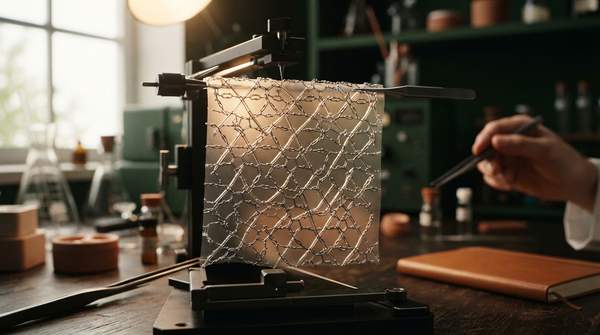
Chemists have now woven a two-dimensional polymer fabric whose strands interlace along three axes instead of the familiar two, using ring-shaped molecules and a boron–nitrogen bonding reaction in place of warp, weft and shuttle. Reported in Nature by a team led from East China Normal University and collaborating institutions, the material is a reticular triaxial woven polymer network — a first for molecular weaving, which until now relied mainly on linear building blocks and biaxial structures. The payoff is a fabric with topological chirality, robust mechanical properties and pores that can separate aromatic from aliphatic compounds.
Introduction to Molecular Weaving
Molecular weaving borrows the logic of the loom and shrinks it to the scale of individual strands. As the Nature authors describe, the technique interlaces molecular strands into ordered networks, and has emerged as a strategy for designing functional materials whose properties emerge from the weave itself rather than from the chemistry of any single strand. A review from the University of Manchester group adds a crucial distinction: whereas a textile weaver pulls a complete weft strand over and under full-length warp threads, molecular weaving does not need to begin from preformed full-length strands. The architecture can assemble itself from smaller pieces, with the interlacing pattern locked in as the network grows.
The field's proof of concept came earlier, when David Leigh's laboratory at the University of Manchester created the first two-dimensional fabric made of molecules woven together. That earlier biaxial material already showed weaving's power: as reported by Chemical & Engineering News, it was twice as stiff as the unwoven linear polymer it was made from, tore along well-defined lines like a textile, and could separate large ions from smaller ones.
From Biaxial to Triaxial: A Structural Leap
Every conventional textile — and every earlier molecular weave — is biaxial: two sets of strands, warp and weft, cross at fixed angles. The Nature paper frames the new work as a deliberate step beyond that limit, noting that higher-order weaving of three or more axes using nonlinear building blocks was expected to produce intriguing architectures and unforeseen functions, but that its construction and property investigation remained underexplored.
The structural leap has two parts. First, the building blocks are no longer linear strands but C₃-symmetric macrocycles — ring-shaped molecules with threefold rotational symmetry, so each ring presents three equivalent connection points spaced at 120 degrees. Second, those three directions of interlacing give the network its triaxial character: instead of two crossing directions, the fabric's topology is defined by three, the same geometry that macroscopic triaxial weaves use to produce fabrics with near-isotropic strength. At the molecular scale, that third axis introduces what the authors call an extra topological dimension for constructing functional materials.
Engineering Triaxial Fabrics: Building Blocks and Process
The construction reported by the Nature team proceeds by incorporating the C₃-symmetric macrocycles directly into the woven structure through dative B–N polymerization — a chemical reaction in which boron and nitrogen atoms form coordinate bonds, stitching the macrocyclic units into an extended, reticular network. Because each macrocycle carries three symmetric connection points, the polymerization does not simply chain units in a line; it propagates the interlacing along three directions simultaneously, so the over-and-under crossing pattern of a fabric emerges as an intrinsic feature of the growing network.
This is where molecular weaving departs most sharply from the loom. There is no shuttle drawing a finished strand through a warp, and no external tension holding the pattern in place. The weave is encoded in the geometry of the macrocycles and the directionality of the B–N bonds, and the resulting two-dimensional sheet is reticular — a net-like lattice — rather than a fabric of independent threads. A companion theoretical study from the Chongqing Institute of East China Normal University and New York University Shanghai underscores why the architecture matters: molecularly woven polymers constructed from identical molecular strands but different weaving architectures are anticipated to display diverse physical and mechanical characteristics.
Comparing Molecular Weave Structures
The table below distills the structural contrast between the earlier biaxial molecular fabrics and the new triaxial network, tracing each weave from its building blocks through its process to the properties that follow.
| Weave type | Structural unit | Weaving process | Resulting properties |
|---|---|---|---|
| Molecular weaving (general principle) | Molecular strands, not preformed full-length threads | Interlaces strands into ordered networks as the structure assembles | Properties emerge from the weave topology itself |
| Biaxial molecular weave (earlier) | Primarily linear building blocks | Interlacing in two primary directions, like warp and weft | Twice as stiff as its unwoven polymer; tears along well-defined lines; separates large ions from smaller ones |
| Triaxial molecular weave (novel) | C₃-symmetric macrocycles with threefold symmetry | Dative B–N polymerization incorporating macrocycles into a two-dimensional reticular network | Topological chirality; robust mechanical properties; porosity enabling separation of aromatic/aliphatic compounds |
Read across the rows, the comparison makes the innovation concrete: the shift from linear strands to threefold-symmetric rings, joined by a directional boron–nitrogen reaction, is what converts a two-axis fabric into a three-axis one — and that single structural change is what the Nature authors credit for the new material's distinctive property set.
Unique Properties of Triaxial Molecular Fabrics
Three properties distinguish the triaxial network. The first is topological chirality: the material is mirror-asymmetric not because of the chemical structure of its individual molecules, but because of the way the strands pass over and under one another — a handedness written into the weave pattern itself. The second is mechanical robustness, which the Nature authors report alongside the chirality as a direct consequence of the triaxial topology; the earlier biaxial fabric's doubling of stiffness relative to its unwoven polymer suggests how strongly weaving architecture can govern mechanical behavior.
The third is porosity. The reticular network is inherently perforated, and the authors demonstrate its function as a porous material that permits the separation of representative aromatic and aliphatic compounds — molecules of similar size that differ in their electronic structure. That selectivity is the paper's clearest evidence that a higher-order weave can regulate material properties in ways simpler architectures cannot.
Potential Applications in Advanced Materials
The demonstrated application is molecular separation: the triaxial fabric's pores discriminate between aromatic and aliphatic compounds, pointing toward filtration membranes that sort molecules by chemical character rather than by size alone. The earlier biaxial fabric's ability to separate large ions from smaller ones, reported by Leigh's group, shows the same principle operating on ionic species.
Beyond separation, the field's trajectory suggests broader possibilities. Leigh has argued that knotting and weaving have always carried great technological impact for humans — enabling weapons, tools, nets and cloth — and that molecular structures may follow the same pattern. The theoretical work from the East China Normal University collaborators reinforces the premise: if identical strands woven into different architectures yield different physical and mechanical characteristics, then weave pattern itself becomes a design variable, opening a route to materials whose stiffness, flexibility or porosity is tuned by topology rather than by changing their chemistry.
These applications remain early-stage. The triaxial fabric exists as a research material characterized in the laboratory, not as a deployed technology, and the discussion of its uses rests on demonstrated separations and on the anticipated diversity of woven architectures rather than on commercial products.
The Future of Molecularly Woven Materials
The triaxial fabric establishes a principle: that researchers are advancing molecular weaving beyond traditional biaxial structures to create materials with enhanced and novel properties. By adding a third weaving axis through C₃-symmetric macrocycles and dative B–N polymerization, the Nature team converted topology itself into a functional design tool — one that delivered chirality, robustness and chemical selectivity in a single material. For readers tracking the field, the measurable indicator of progress is the continued publication of primary research detailing new molecular weaving techniques, C₃-symmetric building blocks, and expanded applications in filtration or advanced textiles. Each such paper will mark another step from woven molecules as a laboratory demonstration toward molecular fabrics as engineering materials.