Textile finishing is the stage where a gray, unfinished fabric becomes fit for its intended purpose. Industry descriptions of the process consistently frame it as a transformation of appearance, feel, absorbency, and durability—turning raw cloth into material with the specific properties an end-use demands. The practical value of understanding finishing is predictive: if you know which category of finish was applied and how that category works, you can anticipate how the fabric will look, feel, and perform.
Understanding Textile Finishing: Aesthetics and Function
Finishing serves two intertwined objectives, and both drive commercial decisions. As Global Textile Times explains, finishing is crucial for improving fabric marketability by making it more appealing and functional; gray fabrics often lack the qualities their intended purposes require, such as water repellency for umbrellas or antimicrobial properties for medical textiles. The aesthetic objective covers color, texture, softness, and hand-feel; the functional objective covers serviceability—resistance, durability, and hygiene performance.
The two objectives frequently converge in a single treatment. Smoothing cotton through calendering changes how the fabric looks and feels; an antimicrobial finish on a medical textile changes how it behaves in service. What unites them is that neither property is inherent to the woven or knitted cloth itself: each is engineered in the finishing stage, which is why two fabrics of identical fiber content can perform very differently.
Mechanical Finishes: Shaping Fabric Structure
Mechanical finishes alter fabric properties through physical action rather than added chemistry. The clearest example in the evidence is calendering, which Global Textile Times describes as a process for smoothing cotton fabrics. The mechanism is compression: the fabric passes through pressure that flattens and evens its surface, and the resulting smoothness is a structural change to the cloth, not a deposited layer.
Because the effect is physical, it belongs to the same broad family of treatments that apparel-industry writing on fabric finishes describes as mechanical processes aimed at enhancing textile performance and aesthetic qualities. The key analytical point for a reader is that mechanical finishes modify what the fabric already is—its surface geometry and structure—rather than adding a new substance to it. That distinction matters when predicting outcomes: a mechanical finish changes texture and surface character, while the functional properties described below come from chemistry or biology.
Chemical Finishes: Engineered Performance
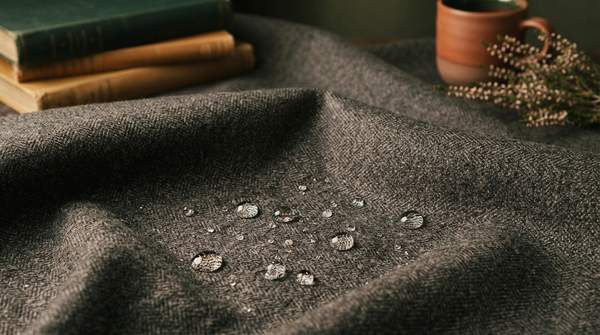
Chemical finishes are where most engineered performance lives. The evidence supports several distinct examples. Water repellency is applied to materials like raincoat fabrics, making them resistant to water absorption. Antimicrobial finishes are applied to medical textiles; technical literature on antibacterial finishes specifies that such treatments must kill or inhibit the growth of pathogenic and odor-causing bacteria, act efficiently against a broad spectrum of harmful bacteria, and avoid adverse effects on the fabric's inherent properties and comfort. Flame resistance is a further chemical treatment, applied for safety by reducing flammability.
Chemical resistance belongs in the same functional family. As Apex Mills explains, a chemical-resistant finish reduces the damage a fabric takes from dangerous chemicals and can protect wearers from harm, which is why companies rely on such fabrics for protective gear used by healthcare and science-sector workers exposed to hazardous materials.
Not all chemical finishing is about depositing a durable agent. Plasma treatment—a form of corona treatment using high voltage—works differently: it increases the fabric's surface energy, improving wetting and chemical interaction. That makes plasma a preparatory or enabling finish, changing how the fabric surface engages with subsequent treatments rather than delivering a property on its own.
Biological/Enzymatic Finishes: Gentle Transformations
Enzymatic finishing uses proteins to act on specific components of the yarn. The best-documented case is cellulase in denim. As summarized in technical literature on textile finishing, cellulases—particularly endoglucanases from Trichoderma reesei—break off the small fiber ends of the cellulosic fraction on the yarn surface, which facilitates abrasion of the indigo dye. Replacing pumice stones with cellulases offers more flexibility, including the ability to create alternative finished looks.
The consequence is industrial-scale: biostoning is now the main stonewashing process used in the jeans finishing industry, a shift the literature connects to reduced processing cost and reduced environmental impact compared with the stone-based process it replaced. Enzymatic finishing thus illustrates a distinct category logic—targeted molecular action on a specific fiber fraction, with a biodegradable agent replacing a harsher physical or chemical method.
Textile Finishing Categories and Their Impacts
The table below classifies the finishing processes described in the evidence into three categories and maps each to its purpose and the fabric properties it alters. Use it to move from a finish name to a predicted outcome: locate the category, read the mechanism, and anticipate the property change.
| Finish Category | Primary Purpose | Example Processes | Key Fabric Properties Affected |
|---|---|---|---|
| Mechanical | Alter surface structure physically, without added chemistry | Calendering (smoothing of cotton fabrics) | Surface smoothness; texture and hand-feel |
| Chemical | Impart functional performance for specific end-uses | Water repellency (raincoat fabrics); antimicrobial finishes (medical textiles); flame resistance; chemical resistance (protective gear) | Water absorption resistance; bacterial growth inhibition; flammability; resistance to chemical damage |
| Chemical (surface activation) | Prepare the surface for further treatment | Plasma treatment (corona treatment, high voltage) | Surface energy; wetting and chemical interaction |
| Biological/Enzymatic | Targeted molecular action on specific fiber components | Cellulase biostoning (denim finishing) | Surface fiber ends; dye abrasion; finished look; softness and texture |
Read across the rows and the classification logic becomes explicit: mechanical processes reshape structure, chemical processes add or engineer function, and enzymatic processes selectively consume a fiber fraction to produce an aesthetic effect. Each category predicts a different class of property change.
Making Informed Material Choices
Two boundaries keep this framework honest. First, the evidence supports the effects described above but not engineering-level specifications for each process, so prediction stays at the level of property direction—smoother, more water-resistant, less flammable—rather than measured magnitudes. Second, finishing is distinct from pre-treatment: scouring, desizing, and bleaching precede finishing and are outside this framework's scope.
The framework also flags where trade-offs sit. Antibacterial finishes, for instance, are specified in the technical literature to have no adverse effect on the fabric's inherent properties and comfort, and to be environmentally safe—criteria a buyer can use as screening questions. Enzymatic routes carry documented cost and environmental advantages in denim, but that evidence is process-specific and should not be generalized to other fabrics without support.
Predicting Fabric Performance from Finishing Choices
When selecting fabrics, consider the finishing processes applied to predict their aesthetic and functional performance for the intended end-use. The decision rule is straightforward: identify the end-use's required properties, then trace each property back to the finishing category that produces it—mechanical for surface character, chemical for protective and hygienic function, enzymatic for targeted aesthetic effects.
The measurable indicator is that the fabric's listed properties—water resistance, softness, antimicrobial behavior, dye-abraded finish—directly correspond to specific finishing treatments. A fabric specified for a raincoat should carry a water-repellent finish; a medical textile should carry an antimicrobial treatment meeting the kill-or-inhibit criterion; a stonewashed jean should show cellulase-based dye abrasion. Where a listed property has no corresponding finishing process behind it, that gap is the question to raise with the supplier before committing to the material.