Printed fabric developed through four pivotal technologies: woodblock printing, roller printing, screen printing, and digital inkjet printing. Each one answered a specific weakness in the method before it. Woodblocks were slow but portable; rollers mechanized them; screens made intricate repeat patterns cheap; inkjets removed the physical tool entirely. If you want to understand why a printed scarf costs what it costs, or why a one-off custom design is now possible at all, this sequence is the story.
The Ancient Roots of Textile Printing: Woodblock Innovation
How do you print a pattern onto cloth without a machine? You carve it. In woodblock printing, a design is drawn on or transferred to a prepared wooden block, and a carver cuts away the wood around it so the pattern stands out in relief, as Wikipedia's entry on textile printing describes. Fine details that are hard to cut in wood are instead built up from strips of brass or copper driven edgewise into the block's surface, a technique known as coppering.
The evidence of fabric prints reaches as far back as the 4th century BC, and the first common method of textile printing originated in China, where woodblock examples from 220 AD have been discovered, according to Rita Patra's historical survey for Patra Selections. Artisans in India and Mesopotamia are generally accepted to have been printing on textiles since the 2nd millennium BC. It was, as the Wikipedia entry bluntly puts it, "the earliest, simplest and slowest of all printing methods."
Why so slow? Each distinct colour in the design requires a separate block, pressed onto the fabric in careful alignment. A Lancashire museums account of calico printing describes the physical routine: colour poured onto a sieve, the block pressed into it, placed on the cloth, "given a sharp tap with a mallet, and lifted away." One block, one colour, one tap at a time. Europe only adopted textile printing around the 12th century through Islamic influence — and at first only for non-washable pieces such as wall hangings, because European dyes dissolved easily in water.
The Industrial Revolution's Leap: Roller Printing
The bottleneck of hand-block printing met its match in 1783, when Thomas Bell of Scotland invented roller printing. As Britannica's technology entry explains, a separate dye paste for each colour is applied to the fabric from a metal roller engraved in intaglio according to the design, and the technique can be used with almost any textile fabric.
Picture the mechanics: a copper roller engraved from end to end with the pattern, mounted against a large central cylinder, with the cloth passing between the two while a furnishing roller feeds the colour along. The Lancashire museums account notes that the printed fabric then moved through a series of steam dryers, and that Bell's prototype was followed in 1784 by a second patent for a multi-roller machine.
The change was enormous. The fabric passed through continuously, so the design printed without stopping, making production both high-speed and consistent, as the Vogue Institute of Art and Design's account describes. Patra's survey adds that the engraved rollers could print up to six different colours at once — far faster than anything before. For the Lancashire cotton trade, the mechanisation of this finishing trade was, in the words of a local history quoted by the museums account, "as important as the inventions of Arkwright and his contemporaries in establishing British pre-eminence in the cotton trade."
Evolution of Textile Printing: A Chronological Timeline
The clearest way to see the succession is to lay the four methods side by side. This timeline arranges each method chronologically, using the emergence dates reported by the sources above, so you can see exactly which capability each new technology introduced — speed, colour capacity, or design flexibility — and what limitation it overcame.
| Method | Era of Emergence | Key Innovation | Impact on Production |
|---|---|---|---|
| Woodblock printing | China, surviving examples from 220 AD; earlier fabric prints from the 4th century BC; India and Mesopotamia since the 2nd millennium BC | Carved relief blocks, one per colour, with brass or copper strips for fine detail; dye applied to the raised surface and pressed onto cloth | The earliest and slowest method; labour-intensive, one tap of the mallet at a time; dominant for centuries before mechanisation |
| Roller (cylinder) printing | 1783, Thomas Bell, Scotland; multi-roller patent 1784 | Intaglio-engraved metal rollers applying a separate dye paste per colour continuously as fabric passes through | High-speed, continuous, consistent output; up to six colours at once; transformed calico printing during the Industrial Revolution |
| Rotary screen printing | Rotary machine developed in the 1960s by artist and inventor Michael Vasilantone; flat screen printing popular earlier across Asia, India and Europe | Stencilled image on a mesh screen, with ink or dye pushed through the mesh by a blade onto the fabric below | Quicker than the traditional flat-bed method; extended design flexibility and repeat pattern work |
| Digital textile printing | Modern era, using rapid inkjet technology | Rapid ink jets applying colour directly, with no physical block, roller or screen | Quickest process yet, and far easier to produce one-off designs; continuously evolving |
Read the table top to bottom and the pattern is unmistakable: each row trades a physical, fixed tool for a faster or more flexible one, moving from the hand-held block to a continuously engraved roller to a blade-pushed mesh to no contact tool at all.
Screen Printing: Versatility and Detail
Screen printing did not begin with the rotary machine. The technique, which originated in China and gained popularity during the 20th century, uses a mesh screen to transfer ink onto the fabric. In its commercial form, a stencilled image is placed onto the mesh, and ink or dye is pushed through it using a blade onto the fabric below.
The decisive leap came in the 1960s, when the artist and inventor Michael Vasilantone developed a rotary machine based on screen printing that was quicker than the traditional flat-bed method. Screen printing had by then already spread throughout Asia, India and Europe, as Patra's survey records. What the method offered was a middle ground: more design flexibility than a fixed engraving, but still a physical, repeatable production tool — a stencil that could be run again and again.
The Digital Age: Unprecedented Flexibility and Speed
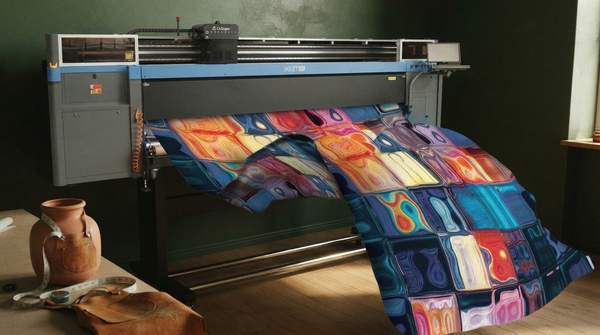
Then the tool disappears entirely. Digital textile printing uses rapid ink jets that, in Patra's account, not only make the process quicker but also make it far easier to produce one-off designs. This is the crucial break with every predecessor: no block to carve, no roller to engrave, no screen to cut.
Consider what that means for you as a designer. Under woodblock printing, a new colour required a new carved block. Under roller printing, a new design required a newly engraved cylinder. Digital printing removes that setup cost from the equation, so a single printed metre and a thousand printed metres can begin from the same file. It is the method Wikipedia's entry lists among the current approaches to impressing coloured patterns on cloth, and it remains a continuously evolving technology rather than a finished one.
Practical Considerations: Fabric, Dyes, and the Printing Process
The method is only half the equation — the fabric and the dye set the boundaries of what is possible. The European experience with woodblock printing is the cautionary example: printed pieces were initially limited to non-washable items such as wall hangings because European dyes of the era dissolved easily in water. The beauty of a print means little if the colour cannot survive its intended use.
Material behaviour also shaped the tools. A design drawn on or transferred to a prepared wooden block, carved so the printing surface stands in relief, worked with the cloth as it was laid flat beneath the mallet. Fine detail demanded coppering — metal strips driven edgewise into the block — because wood alone could not hold it. In every era, the pairing of dye, fabric and tool determined the result: Britannica notes that roller printing's dye pastes could be applied to almost any textile fabric, while a one-off digital print still depends on whether the ink and the cloth are suited to each other.
Choosing the Right Printing Method for Your Design
When selecting a textile printing method, consider the desired production volume, colour complexity, design intricacy, and the specific fabric properties. The historical record gives you a concrete decision ladder: woodblock for slow, hands-on craft with one block per colour; roller printing for continuous, consistent high-speed output of up to six colours; rotary screen printing for quicker stencil-based repeats; digital inkjet for rapid, setup-free one-offs.
The measurable indicator is the successful match between the chosen printing method's capabilities — speed, colour, and detail — and the project's requirements, resulting in the desired aesthetic and functional outcome on the fabric. If a print washes out, the dye was wrong for the use; if a custom single-piece design is needed, the evidence points to digital as the only method in this lineage that makes it easy. Match the method to those constraints, and the outcome on the cloth will show it.
Sources
- Textile printing - Wikipedia — EN
- Grand Designs: Fabric printing through the ages — Patra Selections
- Roller Printing — Stories from Lancashire Museums
- Britannica