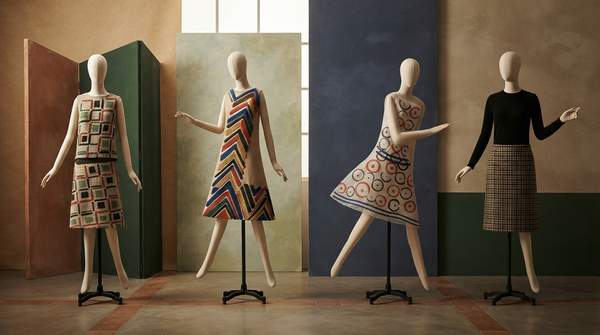
Can you tell a chevron from a sunburst at a glance? You can, and the distinction matters. Art Deco textiles of the 1920s and 1930s were not a single look but a family of recurring pattern types, each shaped by a different set of artistic and cultural forces. This guide breaks the style into identifiable archetypes, so you can look at a vintage dress fabric or upholstery panel and name what you are seeing, and why its designer made it that way.
Introduction to Art Deco Textile Patterns
Art Deco emerged as a deliberate break with the past. As textile house Tessitura Luigi Bevilacqua's design writer Laura Fuser explains, designers of the era "needed a more avant-garde style, which could communicate an idea of movement, as well as of luxury, during an age of economic growth." The result combined sometimes contradictory sources: Cubism, Neoclassicism, abstract art, Futurism, Modernism, and what Fuser calls "primitive" arts, including African, Aztec, Egyptian, and Greek traditions.
The Victoria and Albert Museum traces the style's roots further back, noting that key elements of Art Nouveau's visual language, such as plant and floral forms, were borrowed and adapted into an updated vision, while the more linear, geometric variant of Art Nouveau fed directly into Art Deco's search for modern decorative motifs. In textiles, that search produced bold, contrasting color palettes and a shared grammar of simplified, symmetrical forms.
The Geometric Allure: Chevron and Zigzag Patterns
What does a chevron actually look like? Creative Market's design-history overview of the style lists its distinguishing features plainly: heavy geometric influences, triangular and trapezoidal shapes, zigzags, straight and smooth lines, hard edges, stepped forms, and "chevron (inverted, V-shaped mark) arrangements." When you see a fabric built from repeated V-shapes marching in bands, you are looking at the geometric core of the movement.
Why did designers reach for these forms? Fuser's account of Art Deco's origins points to the movement's inspiration from "all technological innovations, especially related to transport," alongside avant-garde currents like Cubism and Futurism. The sharp, directional energy of a zigzag reads as movement and speed, exactly the qualities a style born in an age of economic growth wanted to project. Your Colors' knowledge base on Art Deco patterns adds that the style's defining characteristics include linear precision and rich color palettes, which the 1920s textile industry translated into luxurious fabrics and fashionable garments.
Radiant Designs: Sunburst and Fan Motifs
The sunburst is one of the easiest Art Deco motifs to identify. Creative Market's overview names "sunburst or sunrise motifs" among the style's core characteristics, alongside streamlined and sleek forms. The pattern places lines radiating outward from a central point, evoking sun rays or an open fan.
What did that radiance mean to its makers? Art Deco Mumbai's illustrated glossary of the style's vocabulary treats the sunburst as a named, definable motif within the movement's decorative dictionary, part of how the style spread globally and acquired local flourishes as it traveled. Artsper Magazine's style guide situates this appetite for symbolic, celebratory forms within Art Deco's broader search for abstract inspiration and exotic cultural elements. A sunburst on a 1920s textile is not decoration alone; it is the movement's optimism rendered in thread.
Nature Reimagined: Stylized Natural and Floral Forms
Here is where Art Deco surprises people who expect only hard geometry. Your Colors explains that while rooted in geometry, the style also incorporated natural and figurative elements, "always in a highly stylized and abstracted manner." Animals such as gazelles, panthers, and birds, human figures, and botanical forms were simplified into their essential geometric components, losing naturalistic detail in favor of elegant, decorative outlines that could slot seamlessly into geometric frameworks.
The V&A gives this lineage a concrete anchor: the stylized naturalistic fabric designs of the Parisian Atelier Martine, whose 1919 French dress fabric the museum holds in its collection. Wikipedia's history of the movement records the same impulse in early Art Deco interiors, where the designer André Mare created wallpaper featuring stylized roses and floral patterns with flamboyant, colorful motifs, a distinct break from traditional décor. Fuser's survey of Art Deco fabrics echoes the formula: simple lines, geometrical and simplified shapes, and primary colors with precious, shiny details.
Key Influences Shaping Art Deco Textiles
Why did these particular patterns appear, and not others? Four forces recur across the evidence:
- The machine age. Creative Market's overview notes that Art Deco was "obsessed with everything Machine Age-related, particularly from approximately 1925 onwards," referring to the period from 1880 to 1945 when technology advanced rapidly through the later Second Industrial Revolution.
- Avant-garde art. Fuser names Cubism, Futurism, abstract art, and Modernism as formative styles the movement combined, with Cubism supplying the geometric abstraction visible throughout.
- Ancient and "exotic" arts. Creative Market's account describes designers infusing their work with "shapes that are distinctly archaeological in nature," including arches, ziggurats, buttresses, and columns. Artsper's guide records a rich selection of cultural motifs drawn from ancient Egypt and Mesopotamia to Asia, Mesoamerica, and Africa.
- Art Nouveau's inheritance. The V&A shows how plant and floral forms from Art Nouveau were adapted into Art Deco's updated vision, and how the linear geometric variant of that earlier style fed directly into the new one.
Your Colors summarizes the synthesis: from these diverse historical influences came the defining characteristics of linear precision, stylized motifs, and rich, contrasting color palettes, which the 1920s textile industry translated into luxurious fabrics and fashionable garments.
Identifying Art Deco Textile Patterns: A Quick Reference
Use this table to sort what you see into pattern families. Each row pairs the visual signature with the forces that produced it, drawn from the sources above.
| Pattern Type | Key Visual Characteristics | Primary Influence(s) |
|---|---|---|
| Chevron & Zigzag | Zigzag lines, triangular and trapezoidal shapes, straight smooth lines, hard edges, stepped forms, and chevron arrangements of inverted V-shaped marks, often repeated in bands. | The machine age's technological optimism, especially from about 1925 onward, combined with the geometric abstraction of Cubism and Futurism's emphasis on movement. |
| Sunburst & Fan | Lines radiating from a central point, resembling sun rays or an open fan, in streamlined, sleek forms. | The era's celebration of progress and modernity, alongside the movement's broader search for abstract and symbolic inspiration. |
| Stylized Natural & Floral | Animals, human figures, and botanical forms simplified into essential geometric components with elegant decorative outlines, symmetrical and abstracted from nature, in bold contrasting colors. | Adapted Art Nouveau floral language, plus archaeological and "exotic" sources including Egyptian, Aztec, Mesopotamian, Asian, Mesoamerican, and African art. |
A note on scope: this table covers the three archetypes best supported by the design literature, not every pattern the movement produced. Creative Market's feature list also names ziggurat patterns, exaggerated curves, and low reliefs among the style's vocabulary, and color here is described only in general terms of boldness and contrast rather than as a technical palette analysis.
Applying Your Knowledge: Spotting Art Deco in Textiles
With these three archetypes in hand, you can confidently identify and categorize Art Deco textile patterns based on their geometric characteristics, stylized forms, and underlying historical influences. The practical test: when you next encounter a vintage fabric, ask which family it belongs to. Repeated V-shapes point to the chevron and zigzag tradition and its machine-age, Cubist-inflected background. Radiating lines point to the sunburst and the era's forward-looking optimism. Simplified gazelles, roses, or foliage rendered as clean geometric outlines point to the stylized natural school, with its Art Nouveau inheritance and its borrowings from Egyptian, Aztec, and other ancient arts.
The measurable indicator of success is simple: you can correctly identify and describe at least three distinct Art Deco textile patterns in visual examples, articulating their key features and influences. When you can name the pattern, its visual signature, and the force behind it, the style stops being a vague label and becomes a legible design language, one the V&A's own collection, from Atelier Martine's 1919 dress fabric onward, lets you practice reading in person.
Sources
- The Patterns of Art Deco Fabrics: Modernity and Elegance Reloaded — Tessitura Luigi Bevilaqua
- An introduction to Art Deco — Victoria and Albert Museum
- Creativemarket
- Art Deco Patterns: Geometric Glamour & 1920s Textiles | Your Colors
- Deco Dictionary: What Is ‘Sunburst’? | Deco Decoded — Art Deco - Digital diarist showcasing Mumbai's Art Deco
- Art Deco Meaning: Everything You Need To Know About the Style — Artsper Magazine
- Art Deco - Wikipedia — EN