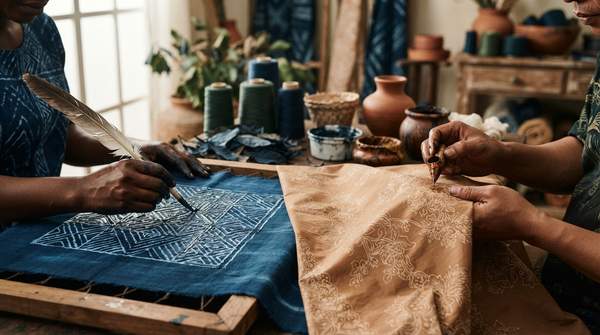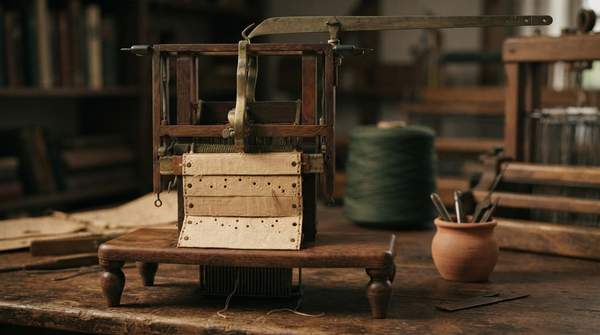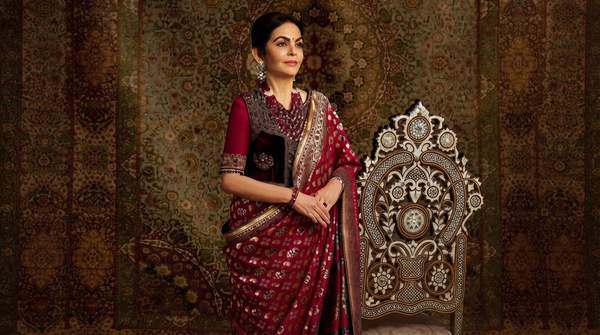
The Ashavali sari is a hand-woven brocade tradition from Ahmedabad in Gujarat, named after the city's earlier incarnation, Ashaval, and built on mulberry silk, gold and silver zari threads, and a supplementary-weft brocade technique guided by perforated cards. References to the style reach back to the 16th century, and its fabrics were once the dress of royalty and nobility. Understanding what makes an Ashavali sari distinctive means understanding both what it is made of and how it is made—two things this article lays out in sequence.
Historical Roots and Royal Patronage
The name carries the geography directly: Ahmedabad, the ancient city earlier known as Ashaval, gave its hand-woven fabric the term Ashavali, and the textile is also called the Amdavadi or Amdavadi zari sari. Accounts of the craft trace its presence in the region back centuries, with weaving in the area described as going back to the 8th century.
Documentary references to Ashavali sarees specifically are found from the 16th century, according to Radhika Lalbhai, who discussed the tradition in an interview conducted in Ahmedabad in November 2017 for Sahapedia. Lalbhai's account places the fabrics among Khatris and Patels, worn primarily by royalty and nobles—not only as saris but as jamas and patkas, and used for canopies and decorations for camels and elephants. Some believe Gujarati weavers who migrated carried the brocade tradition onward to Benaras. A literature review of the tradition notes that the community involved in the craft form includes Wankar and Maheshwari weavers, and that the tradition was popularly known in translation as the "fabric of dreams."
Defining Characteristics: Materials, Weave, and Minakari
Materially, the tradition is defined by its combination of threads. The primary raw material for many brocades is mulberry silk thread, worked together with zari—gold and silver threads—and natural dyes. Earlier Ashavali borders and patterns were woven with golden thread in combination with silk and cotton, using bright and attractive colours.
Technically, Ashavali is a brocade, which means its patterns are created by supplementary weft threads introduced into a base fabric rather than by dyeing or printing. Shoba Narayan, writing on Project LooM, describes the characteristic effect: the motifs appear to float on the sari because they are woven using an alternating twill technique, and they are made with bright, enamelled contrast colours called minakari work. Traditionally the sari was woven on a 105 cm wide pit loom, with a structure of a main field, side borders, and a pallu comprising a minor panel, a major panel, and a cross border. The side borders carried a metallic weft that does not run from selvedge to selvedge.