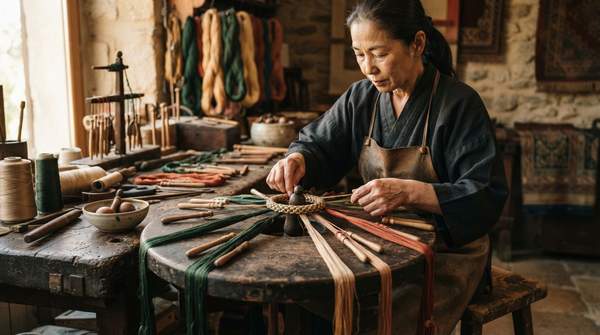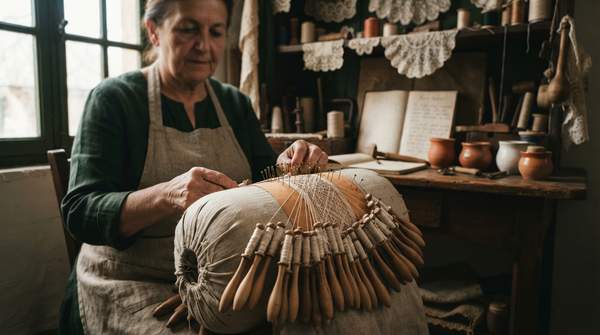
Bobbin lace is an openwork fabric made by manipulating multiple threads wound on small spools, and it evolved from the braiding and weaving techniques of passementerie in late-1400s Italy, according to PieceWork magazine. From there it spread rapidly across the continent, becoming a status symbol adorning neck ruffs and sleeve cuffs. Understanding the craft today means grasping three things: its history, its tools—the pillow, bobbins, pins, and prickings—and the fundamental distinction between straight, part, and tape lace.
The European Origins and Spread of Bobbin Lace
Bobbin lace developed after needlepoint lace, which used a single-thread embroidery technique. As Melinda Watt of the Metropolitan Museum of Art's Heilbrunn Timeline of Art History explains, bobbin lace instead employs a variety of multiple-thread weaving techniques, and it is also known as pillow lace, because it is worked on a pillow, and bone lace, named for early bobbins made of bone.
The craft's dissemination was remarkably fast. The Lace Guild notes that Venice, a major trading centre, printed the first known lace pattern books there in the 1550s—the Le Pompe volumes—and acted as an early hub for spreading lace knowledge. By 1600, high-quality lace was being made in many centres across Europe, including Flanders, Spain, France, and England, with women already practised in other textile crafts picking up the new skills with relative ease. Travelling noblemen and royal intermarriage carried fashion ideas widely, and lace was traded—and smuggled—across borders.
Watt's account traces a similar route: techniques spread to Spain and from there north to the Spanish Netherlands, France, Germany, and England. Demand surged in the seventeenth and eighteenth centuries, and during the first half of the seventeenth century, bobbin-lace techniques multiplied throughout Europe, producing the fine Flemish bobbin tape laces of the United Provinces of Flanders.
In Britain, a historical guide to European laces records that the bobbin lacemaking industry existed from the 16th century and was well established in England by 1600. Its main centres were the East Midlands—Buckinghamshire, Bedfordshire, and Northamptonshire—where straight laces were made, and around Honiton in Devon, which specialized in part laces. Heritage Crafts likewise identifies Devon and the East Midlands as notable UK centres.