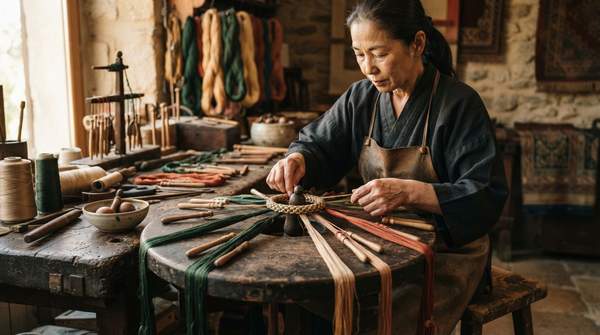
Kumihimo is the traditional Japanese art of braiding silk cords, and its story is best understood through a simple relationship: the stand the braider uses determines the braid the craft produces. A round stand yields round cords, a tall stand yields flat bands, and one unusual stand produces something closer to weaving than braiding at all. That link between tool and product is what carried kumihimo from functional lacing on samurai armor to the decorative silk cords that still fasten kimono sashes today.
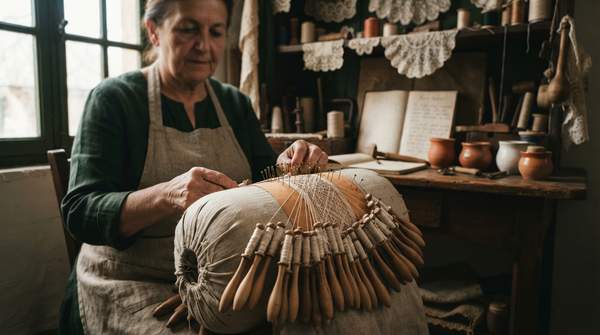
The word itself describes the method: threads are gathered and interlaced, rather than woven on a loom in the conventional sense. The essential equipment is the braiding stand, a wooden frame over which strands of thread are laid and moved in sequence. An exhibition on the craft mounted by Japan House Los Angeles with the Tokyo braiding house Domyo describes these stands as "the most important tools in kumihimo," frames over which the strands are laid during braiding, with large marudai and takadai strung with colorful silk and bobbins to evoke the process.
Traditional Kumihimo Stands: Tools and Their Braids
According to the American Kumihimo Society's techniques listing for its Braids 2025 event, the kumihimo repertoire includes five stands, all of which produce different types of braids. Three of them dominate traditional practice: the marudai, the takadai, and the ayatakedai. Each represents a different answer to the same question — how do you hold tension across many silk strands while interlacing them by hand? — and each answer produces a distinct geometry.
The marudai, which Japan House Los Angeles glosses as the "round stand," is the classic rounded-top table of kumihimo. Strands weighted with bobbins hang over its smooth, circular top, and the braider exchanges them in sequence around the circumference. The structure of the stand — a continuous, symmetrical curve with no beginning or end — suits braids that rotate as they form, and the marudai is the stand associated with the round, square, and other fully rounded cords that historically served as lacing and cords. It is worth noting that the explicit statement that the marudai produces round braids comes from secondary craft sources; the primary exhibition text establishes the stand's round form, and the braid geometry follows from that design.
The takadai, the "tall stand," takes the opposite approach. It is a high, flat-topped frame, often compared to a loom, across which many strands are stretched horizontally. The braider works the strands across the face of the stand, opening sheds and passing bobbins through them. This horizontal, back-and-forth working produces flat, wide braids — the kind of broad, patterned bands suited to belts and sashes rather than cords. As with the marudai, the flat-braid attribution rests partly on practitioner accounts rather than the exhibition text alone, though the "tall stand" description from Japan House Los Angeles clearly marks it as structurally distinct from the round marudai.
The ayatakedai is the outlier. In the American Kumihimo Society's description, prepared for a class taught by Michael Hattori, the technique on this stand "is not braiding, but more closely related to tablet weaving, in that strands are twisted, and weft threads are passed." The braid forms on a straight fell — the edge where the fabric grows — rather than the V-shaped fell typical of many braids. The stand itself uses wooden structures called "hane," or feathers, on which strands are placed and exchanged. The result is a flat, tape-like textile with a woven character, produced by a stand that looks and behaves unlike either of its more famous cousins.