Cochineal is a red dye made from the dried bodies of female scale insects, and its story begins long before European contact with the Americas. Indigenous peoples of Central and South America harvested the insect Dactylopius coccus from prickly pear cacti for centuries, extracting a vivid crimson pigment that would later become one of the most valuable commodities of the Spanish Empire. For artisans and designers working with natural dyes today, cochineal offers both a working material and a window into textile history.
The Ancient Origins of Cochineal Dye
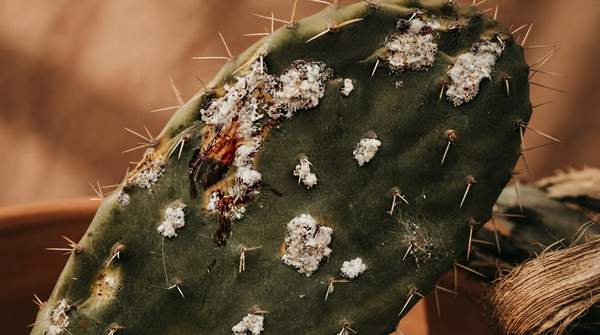
The pigment at the heart of cochineal is carminic acid, and it comes from an unassuming source: small insects that live on cactus plants, primarily Opuntia—the prickly pear. The insects appear as a white bloom of very fine hairs on the cactus paddles, a coating that conceals the red bodies beneath. Harvesters collect the bugs from the paddles and dry them, and it is these dried female insects that carry the dye.
A review of natural and synthetic dyes published in the journal literature describes the fundamental sequence: the insects are harvested, dried, and then crushed to extract the red pigment. What the dyer is after is the carminic acid concentrated in those dried bodies, which dissolves into water and can then be transferred to fiber.
This was no marginal practice. Cochineal, sometimes sold as carmine, has been used for centuries in Central and South America, and it remains in use today as both a natural food dye and a fabric dye. The same pigment that colored pre-Columbian textiles still reaches modern workshops, which is part of what makes cochineal unusual among historical dyes—its commercial and craft life has never fully ended.
Cochineal's Global Journey: From Commodity to Craft
The dye's transformation from regional resource to global commodity began with the Spanish arrival in the Americas. Writing on the natural dye traditions of the world, textile scholar Judy Newland describes the turning point vividly: once the Spanish saw cochineal in the Aztec plazas, they cornered the market and, in her phrasing, "funded their empire on the backs of tiny scale insects."
From there, the red spread. Cochineal traveled from the Americas to Europe and then onward to the Middle East, and textiles colored with this valuable dye can be found in collections all over the world. That geographic footprint matters for anyone studying historical textiles: a crimson garment in a European or Middle Eastern collection may well owe its color to an insect raised on Mexican cactus paddles, carried across oceans as a colonial export.
The dye's importance was not only economic. In Armenia, a different cochineal species was used to color illuminated manuscripts, church frescoes, and royal textiles—an applied-arts tradition that Anoush Arshakyan, writing on Armenian biochrome practices for a textile academy course, characterizes as an early form of biodesign, where nature and human creativity intersected to produce long-lasting materials.