Finishing is what happens to fabric after it is woven or knitted, and it is often the difference between a cloth that feels ordinary and one that feels considered. Broadly, finishes fall into two categories: aesthetic finishes, which modify appearance and hand, and functional finishes, which improve performance. This guide compares four common techniques—calendering, mercerization, napping (raising), and embossing—so you can recognize what has been done to a fabric and choose accordingly.
Calendering: Enhancing Luster and Smoothness
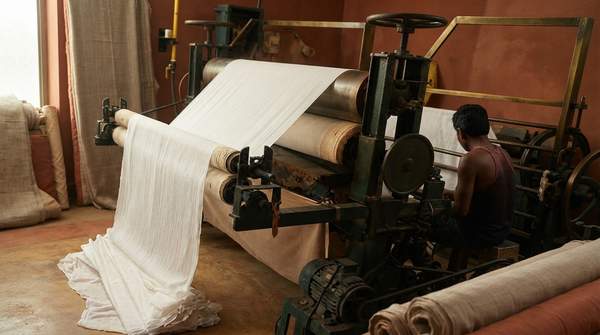
Calendering is a mechanical process: the fabric is passed through rollers under pressure, and the result is a smooth, shiny surface. According to textile industry descriptions, calendering and similar treatments give fabrics a smooth and shiny finish, enhancing their luster and making them more eye-catching.
Why does this matter to you? Because luster is a visual signal. When you pick up a fabric with a polished, light-reflecting surface, calendering is one of the most likely explanations. The treatment enhances visual appeal by increasing luster and brightness, and it can also alter the fabric's thickness as the rollers compress it.
Ask yourself what the fabric is for. A glossy, flattened surface suits formal applications where sheen is the point. If you want a matte, airy hand instead, a calendered fabric is probably working against you.
Mercerization: Boosting Strength, Luster, and Dye Affinity
Mercerization is different in kind: it is a chemical treatment applied to cotton fabric or yarn. The process involves treating the material with a concentrated sodium hydroxide solution while it is held under tension. That tension is essential—it is what keeps the fabric from shrinking freely while the fibers are restructured.
The purpose is threefold. Industry descriptions of the process state that mercerization increases the fabric's strength, luster, and dye affinity. The luster effect overlaps with calendering's, but the mechanism is deeper: the fiber itself is changed, not just its surface.
The dye affinity consequence is the one designers notice most. Improved dye uptake results in more vibrant textiles, so a mercerized cotton will typically read as richer and more saturated than an untreated one. If you are evaluating cotton for color-critical work, mercerization is a property worth asking your supplier about directly.