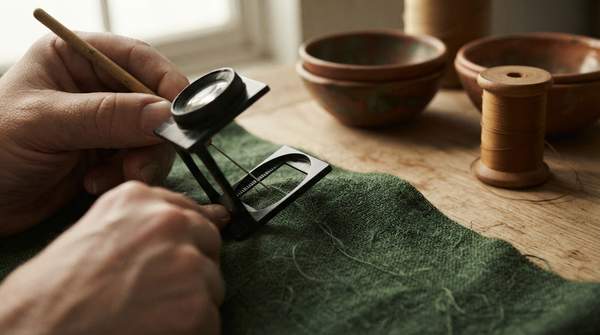
You can judge a fabric's quality in under a minute, with no lab equipment and no textile training. Pinch it, run your hand across it, and look closely at the threads. That is the method bespoke clothiers use, and it works in any store, on any garment, at any price point. The tag, the brand, and the "Super 120s" on the label tell you far less than your own eyes and hands will.
Beyond the Label: Why Physical Fabric Tests Matter
"Luxury fabric" appears on everything from genuine mill cloth to synthetic blends priced above their quality, as the bespoke clothier Vestium NY puts it. The phrase is marketing language, not a specification. So are "ultra-luxury," "premium," and "finest available" — descriptions that show up on fabrics across a wide quality range.
Why does this matter now? The stylist behind Stylist Srushtee argues that the rise of "quiet luxury" has made the gap easier to exploit: some brands produce minimal-looking pieces at premium prices without the underlying construction quality to match. Her breakdown of price drivers is blunt — superior fabric composition and skilled hand-finishing reflect genuine luxury, while brand marketing, artificial scarcity, and retail markup do not.
The solution is to test the material itself. The physical properties of quality cloth can be seen and felt, and they are the reliable indicator.
The 3-Step Fabric Quality Framework: Look, Feel, Pinch
Vestium NY describes a set of simple, non-destructive tests used to evaluate fine wool: check resilience with a pinch-and-release, check surface consistency by running your hand across the cloth, check the hand against skin, and check the drape. According to the clothier, these tests work across fabric types.
Condensed into a repeatable process, the framework is this: Look at fiber and weave consistency, Feel for surface uniformity and smoothness, and Pinch to test resilience. Each step isolates one physical property, and together they give you a qualitative read on construction quality before you spend a cent.
One caveat before you begin: the detailed examples below come from wool, specifically Merino worsted suiting, because that is where the expert guidance is most developed. The principles transfer, but individual fabrics like silk or linen have their own quirks not covered here.
Step 1: Look for Fiber Consistency and Surface Uniformity
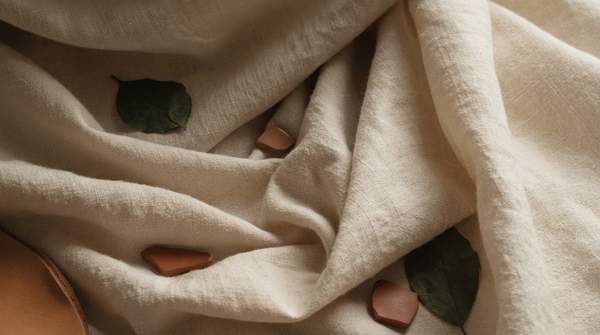
Hold the fabric up and examine the threads closely. In a high-quality cloth, every thread is spun from fibers of consistent diameter. Under magnification, premium Merino wool shows tight, even spinning with minimal variation. Commercial wool, by contrast, shows thicker and thinner areas within the same thread.
You do not need a loupe to apply this. Look for irregularities in the weave: rough patches, thick areas, or uneven sections. Irregularities, Vestium NY notes, are a sign of inconsistent fiber or weaving. A cloth that looks even under normal light is telling you something about the discipline of the mill that spun it.