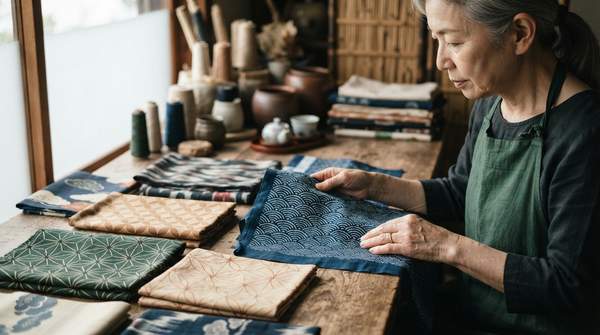
Traditional Japanese clothing speaks in patterns. A kimono's fabric is rarely just decoration: motifs like the hemp-leaf Asanoha, the wave-like Seigaiha, and the interlocking circles of Shippo encode wishes for a child's healthy growth, calm strength, and endless happiness. Once you know the visual grammar, you can look at a garment and read the hopes stitched into it.
These patterns, known collectively as wagara, are easiest to understand when you group them by what inspired them. Some come from the natural world, some from pure geometry, and some from man-made objects. That grouping is a way of organizing meaning, not a rigid historical classification—but it gives you a reliable mental framework for identifying what you see.
Motifs Inspired by Nature: Growth, Resilience, and Beauty
Start with Asanoha, the hemp-leaf pattern. Visually, it is a lattice of six identical diamonds set around a central point, repeating so the star shapes lock together across the cloth. The geometry itself was used across ancient Asia, but as guides to Japanese pattern history note, only in Japan was it read as a hemp leaf—a plant grown widely there and turned into textiles before cotton was imported.
That reading carries the meaning. Hemp grows fast, straight, and hardy even in harsh conditions, so the pattern came to signify growth, strength, and durability. It was placed on children's garments as a hope, worked into the clothes, that the child would grow up healthy and straight. Its early career was religious: the pattern appears on the clothing of Buddhist statuary from the Heian through Muromachi periods, where its aggregate of triangles conveyed protection against evil along with strength and beauty.
Seigaiha, the "blue ocean waves" pattern, is built from overlapping concentric circles that fan out like rolling surf. It once served a practical cartographic role, representing oceans and seas on vintage maps. Symbolically it evokes a peaceful sea, quiet strength, and good fortune. Traditionally rendered in blue, it now appears in many colors.
Nature motifs extend to flowers too. The chrysanthemum (kiku) is believed to ward off evil spirits, offering protection and good fortune, and its intricate form reflects beauty, elegance, and refinement. Kimono sellers note it is especially fitting for Kiku-no-Sekku, the Chrysanthemum Festival held on the ninth day of the ninth month of the lunar calendar.
Geometric Motifs: Protection, Harmony, and Longevity
Uroko, or "scales," is a field of repeating triangles that resembles the scales of a snake or fish. Its power was taken literally: samurai wore clothing with the pattern as a talisman to protect themselves from harm. Here the geometry does the symbolic work—the triangle itself denotes protection against evil, so a fabric of triangles becomes wearable armor.
Shippo, the "seven treasures," is formed from layers of same-sized circles whose overlapping quarters resemble petals, with each center forming a shining star. The circles link into a chain with no beginning or end, and that endlessness is the point: the pattern embodies wishes for family happiness, financial success, harmony, and the prosperity of descendants. It is regarded across sources as deeply auspicious.
What unites these geometric patterns is that their abstraction is not emptiness. An endless chain, a scale, a star of triangles—each abstract form is anchored to a concrete wish. That is the essential habit of wagara: geometry becomes a vehicle for blessing.
Motifs from Objects: Aspiration and Auspiciousness
The third group draws on man-made things. Yabane, also called Yagasuri or arrow feathers, is based on the fletching of hawk and eagle feathers used in arrows. Because arrows fly straight toward a target, they have long served as an auspicious pattern symbolizing determination and the achievement of goals.
Objects work as symbols because of what people did with them. An arrow aims; a scale defends; a treasure circulates. When these objects are abstracted into repeatable textile patterns, their function becomes a permanent, wearable wish. This is why object-inspired motifs tend to carry meanings of aspiration and good luck rather than protection alone.
The same logic applies to motifs like fans, which appear in traditional design references as bearers of auspicious meaning. Across all three categories, the pattern is never arbitrary: it is a compressed cultural message, chosen for the wearer's situation.
The Seven Treasures of Shippo: A Deeper Dive
Why "seven treasures"? The name comes directly from the Buddhist scriptures, where it refers to seven precious substances: gold, silver, lapis lazuli, crystal, agate, red coral, and carnelian. Buddhist study centers and craft traditions alike cite this same list, though the specific treasures can vary slightly across different scriptures and translations.
The design's wordplay is distinctly Japanese. The never-ending linked circles and links share a pronunciation in the language, so the visual endlessness and the connectedness reinforce each other. The result is a pattern that means endless peace and happiness, harmony, unity, and connection between people and things.
Its pedigree is also remarkably wide. The overlapping-circle design is used in both Japan and China, and is known from roughly 3,500 years ago in ancient Egypt. Its enduring beauty, as one woodworking tradition puts it, has let it appeal across generations—evidence that a geometric form carrying a blessing travels well beyond its origin.
Comparative Guide to Key Japanese Textile Motifs
Use this table as a field reference. When you encounter a pattern on a kimono or traditional textile, match its visual form first, then read across for the wish it carries and the context in which it was typically worn.
| Motif | Visual Description | Symbolic Meaning | Cultural Context / Use |
|---|---|---|---|
| Asanoha (hemp leaf) | Six diamonds around a central point forming a six-pointed star, repeating across the cloth | Growth, strength, durability; a wish for a child to grow healthy and straight | Children's garments; earlier, clothing of Buddhist statuary (Heian–Muromachi periods) |
| Seigaiha (blue ocean waves) | Overlapping concentric circles resembling waves; traditionally blue | Peaceful sea, quiet strength, good fortune | Common on Japanese fabrics; once used to depict oceans on vintage maps |
| Shippo (seven treasures) | Layers of same-sized circles overlapping in quarters, forming an endless linked chain | Endless peace and happiness, harmony, unity, prosperity of descendants | Auspicious design for family happiness and financial success; named for seven Buddhist treasures |
| Uroko (scales) | Repeating triangles resembling snake or fish scales | Protection from harm | Worn by samurai as a talisman |
| Yabane / Yagasuri (arrow feathers) | Design based on hawk and eagle feathers used in arrows | Aiming for a target; determination and achievement | Long used as an auspicious kimono pattern |
| Kiku (chrysanthemum) | Intricate, delicate floral pattern | Protection from evil spirits, good fortune, elegance and refinement | Kimono worn for Kiku-no-Sekku, the Chrysanthemum Festival (ninth day of the ninth lunar month) |
Notice how the table confirms the thematic framework. Asanoha, Seigaiha, and Kiku draw on plants and water; Uroko and Shippo are pure geometry carrying protection and harmony; Yabane comes from a made object carrying aspiration. Six motifs, three sources of inspiration, one consistent logic.
Applying Your Understanding of Wagara
When encountering traditional Japanese textiles, identify the motifs present and interpret their symbolic meanings to appreciate the deeper cultural narrative. A star of diamonds on a child's garment is a parent's wish for straight, healthy growth. A fabric of triangles on samurai clothing was worn as a shield. A chain of circles is a blessing without end.
You can check your own reading with a simple measure: the reader can identify at least six motifs—Asanoha, Seigaiha, Shippo, Uroko, Yabane, and Kiku—and articulate their primary symbolic meanings and cultural contexts. If you can look at a patterned textile and name both the motif and the wish behind it, you have unlocked the visual language these garments were designed to speak.
Sources
- Traditional Japanese Patterns and their meanings — Japan Avenue
- Traditional Japanese Patterns: Names, Meanings and Origins — William Morris Wallpaper Co.
- 10 Japanese Patterns (Wagara) Steeped in History and Their Traditional Meaning — BECOS
- Traditional Japanese Patterns — Nippon.com
- What Do Kimono Patterns Symbolize? 10 Traditional Japanese Symbols Explained - Zentner Collection
- Japanese Pattern - Buddha Pāda — Buddha Pāda - Center for the study and practice of Buddhism in all its traditions
- Shippo — kumiko woodworking | Tanihata Co., Ltd. Japan
- What is a Shippo Pattern? The Manufacturing Process Behind Its Beauty — Seo Rain Chain